Complete Library of Christian Doctrines
📚 Doctrine Categories
Filter by Topic
Table of Contents
📖 Christology (Christ)
3 doctrines in this category
Doctrine of the Sustaining Ministry of God the Holy Spirit to the Incarnate Christ
- Definition: During the Incarnation, the humanity of Jesus Christ was sustained by the indwelling presence and filling of God the Holy Spirit from His birth to His death and resurrection.
- The ministry of God the Holy Spirit to the Incarnate Christ was prophesied in the Old Testament (Isa. 11:2; 42:1; 61:1).
- The sustaining ministry of God the Holy Spirit and the virgin birth:
- The Holy Spirit was the agent of conception in the virgin birth of Christ (Matt. 1:18, 20).
- The virgin conception of Christ fulfilled the prophecy in Psalm 40:6 and quoted in Hebrews 10:5b, "A BODY THOU HAST PREPARED FOR ME."
- The total ministry of God the Holy Spirit to the humanity of Christ:
- The Holy Spirit is given "without measure" to the humanity of Christ (John 3:34).
- The Holy Spirit not only indwelt the humanity of Christ as royalty, but He also filled or controlled the soul of the humanity of Christ.
- The Holy Spirit related to the baptism of Christ (Matt. 3:13–17):
- The water in Christ's baptism represented the will of God the Father for the Son in the First Advent.
- Christ's baptism was His identification with and dedication to do the will of the Father in going to the cross.
- The dove represented the omnipotence of God the Holy Spirit who would sustain Him.
- The Holy Spirit related to the public ministry of Christ (Isa. 42:1; Matt. 12:18):
- Jesus performed miracles through the sustaining ministry of God the Holy Spirit, not through the independent function of His own deity (Matt. 12:28).
- The teaching ministry of Christ was performed in the power of the Holy Spirit (Luke 4:14–15).
- The Holy Spirit sustained Jesus Christ in the prototype spiritual life while He bore our sins in His own body on the cross (Heb. 9:14).1
- The Holy Spirit participated in the resurrection of Jesus Christ:
- God the Holy Spirit returned Christ's soul from Hades to His body in the grave (Rom. 8:11a).
- The Holy Spirit sustained Christ during His post-resurrection trip to Tartarus to announce His strategic victory to the incarcerated fallen angels (1 Pet. 3:18–19).
- The sustaining ministry of the Holy Spirit is transferred from the resurrected glorified Christ at the right hand of the Father to the royal family of God who are commanded to avail themselves of this ministry (Eph. 5:18; Gal. 5:16). Jesus Christ was sustained as perfect royalty; believer is sustained as sinful royalty (Eph. 3:16–19).
- The purpose of the sustaining ministry of God the Holy Spirit in the Church Age is the glorification of Christ (John 7:39; 16:14; 1 Cor. 6:19–20).
1 The prototype spiritual life pioneered by the Lord Jesus Christ during the Incarnation was based on the enabling power of God the Holy Spirit and maximum Bible doctrine resident in the soul. The prototype spiritual life is the basis for the divine dynasphere, the operational spiritual life available to every Church Age believer for advancing to the high ground of spiritual maturity and glorification of Christ (1 Cor. 1:24; Eph. 3:9–11). Thieme, Christian Integrity (2002), 9–14.
📖 Pneumatology (Holy Spirit)
1 doctrine in this category
Doctrine of the Ministry of the Holy Spirit
- Ministry of the Holy Spirit in the Old Testament.
- Regeneration.
- Enduement—enabled a few divinely appointed believers to perform special functions (Gen. 41:38; Ex. 28:3; Judg. 3:10; 1 Sam. 10:10) and could be removed for discipline (Ps. 51:11).
- Ministry of the Holy Spirit in the Church Age.
- Salvation ministry.
- Efficacious grace (Eph. 2:8–9)
- Regeneration (John 3:1–16; Titus 3:5).
- Baptism (Acts 1:5; 1 Cor. 12:13; Eph. 4:5).
- Indwelling (Rom. 8:9; 1 Cor. 6:19–20).
- Sealing (2 Cor. 1:22; Eph. 1:13; 4:30).
- Distribution of spiritual gifts (1 Cor. 12:11).
- Postsalvation ministry: the filling of the Holy Spirit that produces spirituality (Eph. 5:18).
- Spirituality and carnality, mutually exclusive absolutes (1 John 3:4–9).
- Spirituality lost through carnality; recovered through rebound (Prov. 1:23; 1 John 1:9).
- Spirituality, a function of the royal priesthood—not subject to Levitical priesthood of Mosaic Law (Rom. 8:2–4; 10:4; 13:8; Gal. 5:18).
- Character of incarnate Christ produced in believer (Gal. 4:19; 5:22–23).
- Not characterized by emotion or tabooism (Rom. 16:17–18; 2 Cor. 6:11–12).
- General objectives of spirituality.
- Partakers of the divine nature (2 Pet. 1:4).
- Imitation of God (2 Cor. 3:3; Eph. 5:1).
- Glorification of Christ (John 7:39; 16:14; 1 Cor. 6:19–20).
- Fulfillment of the Law (Rom. 8:2–4).
- Proper function of faith perception—assimilation of Bible doctrine (John 14:26; 16:12–14; 1 Cor. 2:9–16).
- Salvation ministry.
- Ministry of the Holy Spirit to the unbeliever.
- Restraining (2 Thess. 2:7).
- Convicting (John 16:7–11).
- Regenerating (John 3:5).
📖 Theology Proper (God)
3 doctrines in this category
Doctrine of Divine Essence
- Principles
- God is one in essence: the oneness of God or the glory of God refers to His essence (John 10:30).
- The Trinity is one in essence but has three separate personalities.
- All of the characteristics of divine essence are eternally resident in God, but not all are manifest at one time.
- Examples of how divine essence is manifest
- In salvation: love
- In God's plan: omniscience and sovereignty
- In God's will: sovereignty
- In faithfulness: immutability and veracity
- In God's revelation: veracity and omniscience
- In judgment: righteousness and justice
- In resurrection: eternal life
- The characteristics of the essence of God
- Love: the most important overall concept in the essence of God.
- God is eternal and unchangeable love. God's love never diminishes or increases (1 John 4:8b; 4:16).
- God's love exists with or without a created object because God loves his own perfect character (Ps. 33:5).
- God's love needs no response, no reassurance, no demonstrations of faithfulness from its object.
- God's love can never be compromised because it operates on His righteousness, His absolute perfection, and on His justice, His absolute fairness.
- The love of God is expressed in three categories:
- Divine self-love: Each member of the Trinity loves His own righteousness and loves the other two members of the Godhead, who possess equivalent righteousness.
- Divine personal love: God personally loves every believer because every believer possesses the perfect, imputed righteousness of God (Rom. 8:39; cf. 2 Cor. 5:21).
- Divine impersonal love: God loves every unbeliever with impersonal love (John 3:16), because His love depends on His own righteousness and justice, not on the merit or attractiveness of the object.
- Sovereignty
- God is the Supreme Being of the universe (Deut. 4:39; 1 Sam. 2:6–8; 1 Chron. 29:11; 2 Chron. 20:6; Ps. 83:18; Isa. 45:5–6; Acts 17:24).
- God is King of heaven and earth (Ps. 47:2; 93:1a; Matt. 6:13; Heb. 8:1; Rev. 4:2–3).
- God is eternal (Ps. 93:2), infinite (Ps. 8:1; Acts 5:39; Heb. 6:13), and self-determining (Job 9:12; Ps. 115:3; 135:6; Prov. 21:1; Dan. 4:35).
- The expression of divine volition (Isa. 46:10b; Eph. 1:5) resulted in the plan for humanity (Ps. 24; Heb. 6:17).
- Salvation (John 1:13; Rom. 9:15–23).
- Postsalvation life and provision (Eph. 4:4–13).
- Righteousness
- God is absolute holiness and righteousness (Lev. 19:2b; 1 Sam. 2:2; Ps. 22:3; 47:8; 111:9; Isa. 6:3; John 17:11; Rev. 3:7; 4:8; 6:10).
- God is goodness (Ps. 25:8; 34:8; 86:5; 119:68; Luke 18:19).
- He is free from sin (2 Cor. 5:21; 1 John 1:5).
- He is perfect in His character and person (Deut. 32:4b; Ps. 7:9; 11:7; 97:6; 111:3; 119:137a; Jer. 23:6; John 17:25a; Rom. 1:17; 10:3; 1 John 2:29).
- He is righteous in all His attitudes, actions, and standards (Deut. 32:4a; 2 Sam. 22:31a; Ps. 119:137b; 145:17; Dan. 9:14; Rev. 19:2, 11).
- Justice
- It is impossible for God to do anything unfair. God's judgments are perfect. Justice administers the penalty that righteousness demands (Deut. 32:4; 2 Chron. 19:7; Job 37:23; Ps. 19:9; 50:6; 58:11; 89:14; Isa. 45:21; Jer. 50:7; Rom. 3:26; Heb. 10:30–31; 12:23).
- Divine justice is best exemplified in the plan of redemption:
- The Lord Jesus Christ, through His vicarious, efficacious spiritual death (1 Pet. 2:24), transferred the guilt of all sinners (Rom. 5:12; 6:23) upon Himself, and this satisfied the perfect justice of the Father.
- God is now free to pardon and justify the sinner who accepts His saving grace (Rom. 3:21–28; 4:5; 8:1).
- God is equally free to justly condemn all who reject Christ as Savior (John 3:18, 36; 5:28–30).
- The basis of the unbeliever's indictment is his works, never his sins (Rev. 20:11–15).
- Judgment belongs to Him who was judged on the cross for us (John 5:22; Heb. 9:27–28).
- When the believer judges himself in rebound, there is no judgment from God (1 Cor. 11:31).
- Eternal Life
- God is absolute existence, Yahweh, "the self-existent One who reveals Himself" (Ex. 3:14; John 8:58).
- God has neither beginning (Gen. 1:1a; Isa. 43:13a; Col. 1:17) nor end (Deut. 32:40; 33:27; Job 36:26; Ps. 9:7; 90:2; 102:27; 135:13; Lam. 5:19; Hab. 3:6; John 1:1–4; 1 Tim. 1:17; 1 John 5:11; Rev. 1:8; 21:6; 22:13).
- The believer who expresses faith alone in Christ alone receives eternal life (John 3:16; 10:28–29; 1 John 5:11) and eternal assurance (John 8:51; 14:1–3).
- The unbeliever who rejects Christ receives eternal judgment (Matt. 25:46a; John 8:24).
- Omniscience
- God knows all the knowable. His infinite knowledge is not subject to or confined to time (1 Sam. 2:3; Job 26:6; 31:4; 34:21; 37:16; 42:2b; Ps. 139:1–6, 12; 147:4; Jer. 16:17; Ezek. 11:5; Matt. 10:29–30; Heb. 4:13).
- He is infinite in wisdom and understanding (1 Sam. 16:7; Ps. 44:21; 147:5b; Prov. 3:19; 5:21; 17:3; Isa. 40:13–14; Jer. 17:10; 51:15; Nah. 1:7; Matt. 6:8; Rom. 8:27; 11:33; 1 John 3:20).
- He knows the end from the beginning (foreknowledge) (Isa. 41:26; 42:9; 43:9; 46:10; Acts 2:23; 15:18; 1 Pet. 1:2a).
- As God, the Lord Jesus Christ knew all things and all men (Matt. 9:4; John 2:24; 19:28; 21:17).
- God has always known about every believer (Job 23:10; Matt. 6:31–32; John 13:7; Rom. 8:28; Col. 1:10; James 1:5; 3:17).
- Omnipresence
- God is ever-present, limited by neither time nor space—immanent and transcendent (Jer. 23:24; Acts 17:27).
- The heavens cannot contain Him (1 Kings 8:27; Acts 17:24b).
- Heaven is His throne; the earth, His footstool (Deut. 4:39; Isa. 66:1b).
- Man cannot escape the presence of God (Job 34:21–22; Ps. 139:7–10; Prov. 15:3).
- Omnipotence
- God is all-powerful, limitless in ability, compatible with His holy character (Gen. 17:1; 18:14; Job 26:7; 42:2; Ps. 24:8; 93:1; 147:5a; Isa. 40:26; 50:2; Jer. 27:5; 32:27; Matt. 19:26; Mark 14:36a; Luke 1:37; Rev. 4:8).
- God is limitless in authority (Ps. 33:9; Rom. 13:1; Heb. 1:3; Rev. 19:6).
- His power is manifest throughout the earth (2 Chron. 16:9; 25:8; Ps. 74:13).
- Power of the Son (Matt. 9:6; 28:18; John 10:18; 17:2–3).
- Divine omnipotence keeps and protects believers (1 Sam. 17:47; Ps. 27:1; Isa. 26:4; 40:29; Jer. 33:3; Acts 1:8; 2 Cor. 9:8; Eph. 1:19; 3:20; 2 Tim. 1:12; 1 Pet. 1:5).
- Immutability
- God is neither capable of nor susceptible to change (Ps. 102:26–27; Mal. 3:6; Heb. 1:12).
- He is absolute stability (Isa. 40:28; James 1:17).
- His Word and His works are unchanging: Word (Ps. 119:89; 138:2b; 148:6; Isa. 40:8; 1 Pet. 1:25); works (Eccl. 3:14).
- From His immutability stems His great faithfulness (Lam. 3:22–23).
- Faithful to keep His promises (Num. 23:19; 1 Kings 8:56; 2 Cor. 1:20; Titus 1:2; Heb. 10:23; 11:11).
- Faithful to forgive (1 John 1:9).
- Faithful to keep us saved (2 Tim. 2:12–13).
- Faithful to deliver in pressure (1 Cor. 10:13) and faithful in suffering (1 Pet. 4:19).
- Faithful in His plan (1 Cor. 1:9).
- Faithful in His provision (1 Thess. 5:24).
- Faithful to stabilize the believer (2 Thess. 3:3).
- Christ was faithful to the Father (Heb. 3:1–2; 13:8; Rev. 1:5; 19:11).
- Veracity
- God is absolute truth (Deut. 32:4b).
- Veracity belongs to the Godhead:
- The Father (Ps. 31:5; Isa. 65:16; Jer. 10:10a; John 3:33; 17:3; Rom. 3:4).
- The Son (John 1:14; 8:32; 14:6; 1 John 5:20; Rev. 16:7; 19:11).
- The Holy Spirit (John 14:17; 15:26; 16:13; 1 John 5:7).
- Love: the most important overall concept in the essence of God.
Doctrine of the Hypostatic Union
-
Definition of the Hypostatic Union:
In the person of the incarnate Christ are two natures, divine and human, inseparably united without mixture or loss of separate identity, without loss or transfer of properties or attributes, the union being personal and eternal. -
The Greek term:
- The term hypostatic is derived from the compound Greek word ὑπόστασις (hypostasis) meaning “actual being, essence, substantial nature, setting or placing under, that which has actual existence, taking a thing on oneself.”
- The compound Greek word is derived from ὑπο (hypo) meaning “under” and στασις (stasis) meaning “to stand.”
- Hypostasis therefore comes to mean “to stand under, to take a characteristic upon oneself.”
- Jesus Christ took upon Himself as deity true humanity (John 1:1–3; Rom. 1:3–5; 1 Tim. 3:16).
- The union consummated at the virgin birth or First Advent is a personal or hypostatic union in that Christ is one person, not two.
- Jesus Christ is at the same time God and man with no mixture of the two natures to form a third substance or hypostasis.
- The divine nature always remains the divine nature and the human nature always remains the human nature.
-
The Lord Jesus Christ is unique in the universe.
- He is the God-man.
- He is undiminished deity and true humanity in one person forever.
- He is different from the other members of the Trinity in that He is true humanity.
- He is different from mankind in that He is eternal God.
- Since the First Advent, it is no longer the divine nature alone which is expressed in His person, but the human nature as well.
- He is the God-man.
-
The hypostatic union refers to the whole person of Jesus Christ as distinguished from His two natures.
- The word nature is derived from the Greek participle οὐσία (ousia) of the verb εἰμί (eimi) meaning “to be.” Ousia means “being, existing,” but comes to mean “nature.”
- The two natures of Christ maintain their complete identity though being joined in personal union forever.
- It is impossible to transfer an attribute of one nature to the other nature without destroying that nature.
- To take from Christ a single attribute of His deity would destroy His deity.
- To take from Christ a single attribute of His humanity would destroy His humanity.
- Each nature has its own attributes which are inherent to that nature.
- All the attributes of deity adhere to His deity and never cross over and become humanity.
- All the attributes of humanity adhere to His humanity and never cross over and become deity.
- In the hypostatic union of Christ, no attribute of divine essence is compromised or changed, diminished or destroyed. The essence of God is immutable (Heb. 13:8).
- However in fulfilling God the Father’s plan, purpose, and policy for the Incarnation certain attributes of Christ were not used (Phil. 2:5–8).
- “Emptied” is derived from the Greek κενόω (kenoo) and means “to deprive oneself of a rightful function,” and refers to Jesus Christ’s willing restriction of the independent use of His divine attributes (Heb. 2:6–10; 10:5–7).
- While Christ retained all the attributes of His divine nature, He never used His divine attributes to benefit, provide, or to glorify Himself (Matt. 4:3–4).
-
Jesus Christ is God with all the attributes of God and He is perfect humanity. The two natures remain distinct, whole, unchanged, without mixture or confusion, so that Jesus Christ remains forever truly God and truly man.
- Jesus Christ is eternal God.
- All divine titles are ascribed to Christ: “God” (John 1:1); “God, the Almighty” (Rev. 19:6); God “over all” (Rom. 9:5); “our great God” (Titus 2:13); and “Lord,” the Greek word κύριος (kurios) for deity (Phil. 2:11).
- All divine attributes are ascribed to Christ.
- He declared His eternal existence (John 8:58).
- He is declared to be the creator and sustainer of the universe (Col. 1:16–17); He “upholds all things by the word of His power” (Heb. 1:3).
- He is immutable (Heb. 13:8); and the “radiance of His [God’s] glory” (Heb. 1:3).
- Jesus Christ declared that He and the Father are one in essence (John 8:58; 10:30).
- As eternal, infinite God, Jesus Christ is coequal with God the Father and God the Holy Spirit (John 10:30; 2 Cor. 13:14).
- As eternal, infinite God, Jesus Christ is superior to both angels and mankind (Deut. 6:4; Heb. 1:2).
- Jesus Christ is true humanity.
- The humanity of Christ is said to have flesh and blood (Heb. 2:14; 1 John 4:2).
- Jesus Christ was born into the human race perfect—without a sin nature, and trichotomous—body, soul, and spirit—through the virgin pregnancy and birth (Matt. 1:20).
- Jesus was fully aware of His deity from birth (Heb. 10:5–10).
- Jesus had normal physical development (Luke 2:52).
- Jesus experienced pleasure and rest (Matt. 8:25; 9:10); suffered pain, sorrow, hunger, thirst, fatigue, and death (Matt. 4:2; 14:14; John 11:35; 19:28, 33).
- After three days in the grave, Jesus was raised from the dead and received a resurrection body (Matt. 16:21; 28:6).
- The humanity of Jesus Christ was temptable, but remained sinless (2 Cor. 5:21; Heb. 4:15; 7:26; 1 Pet. 2:22; 1 John 3:5).
- Jesus Christ had names and titles associated with His humanity: “the man Christ Jesus” (1 Tim. 2:5); “Son of Man” (Matt. 20:28); “A man of sorrows” (Isa. 53:3); “son of David” (Matt. 1:1); and “Jesus” (Matt. 1:16).
- Jesus Christ is eternal God.
-
The purpose of the hypostatic union: Jesus Christ had to become perfect humanity!important;
- To be our savior (Heb. 2:14–15; Phil. 2:7–8).
- To be our great high priest to represent man to God (Heb. 7:14—8:2; 10:5, 10–14).
- To be the mediator between God and man (Job 9:2, 32–33; 1 Tim. 2:5–6).
- To fulfill the promise of the Davidic covenant that David’s son would rule forever (2 Sam. 7:8–16; Ps. 89:20–37).
-
Impeccability of the hypostatic union:
- As the God-man, Jesus Christ is both non posse peccare and posse non peccare. These Latin phrases refer to the impeccability of Jesus Christ.
- Non posse peccare means “not able to sin” and refers to the deity of Jesus Christ.
- As God, Jesus Christ is not able to sin, solicit to sin, compromise with sin, or have anything to do with sin except to judge it.
- The deity of Christ is neither temptable nor peccable.
- Posse non peccare means “able not to sin” and refers to the humanity of Jesus Christ.
- By means of the sustaining ministry of God the Holy Spirit and maximum Bible doctrine resident in His soul, Jesus Christ resisted every temptation to sin and remained absolutely perfect.
- The humanity of Christ was temptable, but impeccable.
- Non posse peccare means “not able to sin” and refers to the deity of Jesus Christ.
- During the Incarnation, Jesus Christ in hypostatic union was temptable but impeccable (Heb. 4:15).
- As the God-man, Jesus Christ is both non posse peccare and posse non peccare. These Latin phrases refer to the impeccability of Jesus Christ.
-
The communion of attributes:
- Whatever the Bible says about either the divine or human nature of Christ must be attributed to the entire person, yet without transfer of attributes.
- Some attributes are true of His whole person: prophet, priest, and king (Matt. 11:28; John 14:6; Heb. 10:5–10; 1 Cor. 11:24; 2 Cor. 5:21).
- Some attributes are true only of His deity but the whole person is the subject (John 8:58).
- Some attributes are true only of His humanity but the whole person is the subject (John 19:28).
- Whatever is true of either nature is true of the entire person of Christ in hypostatic union.
- While the characteristics of one nature are never attributed to the other nature, the attributes of both natures contribute to the Person. This is why the Lord in hypostatic union could be both weak and omnipotent, increasing in knowledge and omniscient, finite and infinite during the First Advent.
- The predicates of each nature:
- The person of Christ is described according to His divine nature, but that which is predicated or affirmed is an attribute of His human nature. In Revelation 1:18a, the deity and glory of Christ is described, yet Christ is revealed as “I was dead, and behold, I am alive forevermore.”
- The person of Christ is described according to His human nature, but the predicate states the divine nature. In John 6:62, “the Son of Man” is a title of the humanity of Christ while “ascending where He was before” refers to His divine nature.
- The person of Christ is described according to His divine nature, but the predicate states both natures. In John 5:25–27, Christ, as “the Son of God,” a reference to His deity, resurrects the dead and as “the Son of Man,” a reference to his humanity, executes judgment from hypostatic union, from both natures.
- The person of Christ is described according to His human nature, but the predicate states both natures. On the cross when Jesus Christ screamed the words, “MY GOD, MY GOD, WHY HAST THOU FORSAKEN ME?” (Matt. 27:46), the humanity of Christ was being judged for the sins of the world, yet both natures were present. There was no separation of the humanity and deity of Christ on the cross. Christ, as God, was present because deity is omnipresent, both immanent and transcendent.
- Whatever the Bible says about either the divine or human nature of Christ must be attributed to the entire person, yet without transfer of attributes.
-
Biblical documentation for the hypostatic union:
- John 1:1–2: “In a beginning which was not a beginning there always existed the Word [deity of Christ], and the Word was face-to-face with God, and the Word was God. He was in the beginning with God. All things came into being by Him, and apart from Him nothing came into being that has come into being” (corrected translation).
- John 1:14: “And the Word [the deity of Christ] became flesh [true humanity] and tabernacled among us, and we saw His glory, glory as of the unique one from the Father, full of grace and doctrine” (corrected translation).
- Philippians 2:5–11: “Keep on thinking this in you which was also in Christ Jesus, who though He existed in the essence [deity] of God, He did not think equality with God a gain to be seized, but He laid aside His privileges [kenosis] taking the form of a servant, having come to be in the likeness of men. And being found in appearance as a man, He humbled Himself by becoming obedient to the point of [substitutionary spiritual] death, even the death of the cross. Therefore also, God highly exalted Him and gave Him a name [a royal patent] which is above every name, that at the name of Jesus every knee should bow and every tongue should confess that Jesus is Lord to the glory of the Father” (corrected translation).
- Hebrews 2:14: “Therefore, since children [homo sapiens] share blood and flesh, He also partook of the same [became true humanity], in order that through [substitutionary spiritual] death, He neutralized [rendered powerless] Satan who had the power of death” (corrected translation).
- Romans 1:3–5: “Concerning His Son [deity] who was born from the seed of David according to the flesh [humanity], who has been demonstrated the Son of God by means of power according to the Holy Spirit because of the resurrection… Jesus Christ our Lord [deity]” (corrected translation).
- Romans 9:5b: “And from whom is the Christ in so far as the flesh is concerned, who is God sovereign over all” (corrected translation).
- 1 Timothy 3:16: “And by common acknowledgment, great is the mystery of the spiritual life: He who was revealed in the flesh, was vindicated by the Spirit, seen by angels, proclaimed among the nations, believed on in the world, taken up into glory” (corrected translation).
- Hebrews 1:3: “Who being the flashing forth of the glory, and the exact image of His essence; also sustaining all things by the Word of His power, having Himself accomplished purification for sins [function of His humanity], He was caused to sit down at the right hand of the majesty on high [only humanity sits]” (corrected translation).
Doctrine of the Angel of Yahweh
- The Angel of Yahweh is identified as Yahweh, the God of Israel (Gen. 16:7–13; 22:11–18; Ex. 3:2 [cf. Acts 7:30–35]; Judg. 6:11–23).
- The Angel of Yahweh is distinct from Yahweh (Gen. 24:7, 40; Ex. 23:20; 32:34; Num. 20:16; 1 Chron. 21:15–18; Zech. 1:12–13).
- The Angel of Yahweh is the Second Person of the Trinity:
- The Second Person is the visible God of the New Testament (John 1:18; 6:46; 1 Tim. 6:16; 1 John 4:12).
- The Angel of Yahweh never appears after the Incarnation.
- Both the Angel of Yahweh and Jesus Christ are sent by the Father.
- Since both the Father and the Holy Spirit cannot be seen by man, and since Christ has been seen, it is concluded that Christ is the Angel of Yahweh or the visible member of the Godhead in the Old Testament. The appearance of Christ in the Old Testament is called a theophany.
Doctrine of Imputation
- Definition: Imputation means to reckon, to attribute, to ascribe, or to charge to one’s account.
- While Jesus Christ was on the cross, God the Father imputed all the sins of the human race to Him (2 Cor. 5:21).
- Because the sins of the human race were imputed to Christ on the cross, God is free to impute His perfect righteousness to the believer at the moment of faith in Christ (Rom. 3:22).
- Abraham is the pattern of imputation of divine righteousness for all believers (Gen. 15:6; Rom. 4:3).
- He believed or had faith in the Lord.
- God counted, reckoned, or imputed it to him as righteousness.
- Divine righteousness is imputed only on the basis of faith alone in Christ alone (Rom. 3:22).
- Many Gentiles during Old Testament times attained God’s righteousness by believing in Christ, while many Jews seeking righteousness from obedience to the Mosaic Law never attained the righteousness of God (Rom. 9:30–33).
- Imputation is the basis of justification (Rom. 4:22; 5:1).
- The imputation of perfect righteousness establishes the potential for great blessing in both time and eternity.
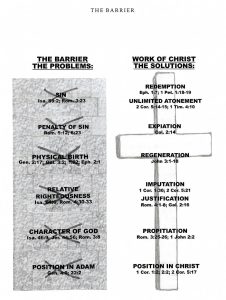
The Barrier

Doctrine of Grace
-
Definition
- Grace is all that God is free to do for man on the basis of the work of Jesus Christ on the cross.
- Grace depends on the essence or character of God.
- Grace is what God can do for man and still be consistent with His own character. This is illustrated by the doctrine of propitiation. Propitiation means “to satisfy” and is God’s view of the cross. God the Father is satisfied with the work of Christ on the cross on behalf of sinful man. Thus, God blesses the believer with salvation, spiritual assets for the Christian life, and eternity in heaven based on Christ’s perfect work, not our work.
- The divine policy of grace is the precedent for the Christian way of living and giving. God supplies the apparatus for assimilating doctrine (GAP) as the basis upon which believers live. God also provides the material resources from which believers give. The result is living and giving that reflects His plan. Grace orientation is the bona fide motivation and attitude for giving (2 Cor. 8:9).
- Grace is the antithesis of legalism. Legalism is man’s attempt to observe a strict standard of behavior and thereby gain the approval of God. Even if the standards are true, man’s work cannot bring him to God. Legalism is the enemy of grace.
- God has provided everything for salvation. Man responds in a totally nonmeritorious manner: by faith (Rom. 3:22–24; 5:19–21; Eph. 2:8–9).
-
Under the concept of grace, the greatest thing that God can do for the saved person is to make him exactly like His Son, Jesus Christ (Rom. 8:29). This is sanctification, which is accomplished in three stages:
- Positional sanctification: Every believer at the point of salvation is entered into union with Christ through the baptism of the Spirit (1 Cor. 12:13). In His resurrected humanity Christ is seated at the right hand of the Father (Eph. 1:20). As one with Christ every believer shares His exalted position (Eph. 2:6).
- Experiential sanctification: This is the Christian way of life, the spiritual growth of believers through the consistent intake of Bible doctrine. The result: continual progress in the process of maturing spiritually (Eph. 4:11–16).
- Ultimate sanctification: The final stage of sanctification promotes all Church Age believers to a state of perfection and glorification in eternity. All receive resurrection bodies like that of Christ (Phil. 3:21; 2 Thess. 2:14; 1 John 3:2).3
- Every believer has “tasted the kindness [grace] of the Lord” at least once (1 Pet. 2:3). This verse refers to the point of salvation, when the believer receives at least forty grace gifts from God, which are unearned and undeserved.4
- Disorientation to grace is the believer’s greatest occupational hazard (Gal. 5:4). Falling from grace is not loss of salvation, but it is rejecting grace and accepting legalism or some other human system of pseudosanctification.
- God is constantly waiting to pour out His grace on every believer (Isa. 30:18–19).
- The Christian way of life expresses grace in many ways, for example: prayer (Heb. 4:16); suffering (2 Cor. 12:9–10); growth (2 Pet. 3:18); stability (1 Pet. 5:12); the modus vivendi of the Christian life (2 Cor. 1:12; Heb. 12:28); and the production of divine good (1 Cor. 15:10; 2 Cor. 6:1).
- Grace is sufficient for enduring all suffering. Through grace God is able to bless the believer in the midst of pressure, hardship, and adversity (2 Cor. 12:7–10).
-
The axioms of grace
- God is perfect; His plan is perfect.
- A perfect plan can originate only from a perfect God.
- If imperfect man can do anything meritorious, then God’s plan is no longer perfect. Grace, which excludes human merit, protects the perfection of God’s plan.
- A plan is like a chain, which is no stronger than its weakest link. Grace excludes human merit, human ability, human good, and, therefore, the plan of God has no weak links.
- Human works cannot accomplish the plan of God. Human virtue always falls short of God’s absolute standards.
- Human good, when assumed to be man’s approach to God, expresses arrogance.
-
Arrogance rejects grace
- The arrogance of the believer who rejects the doctrine of eternal security: he assumes his sins are greater than the plan of God.
- The arrogance of the believer who succumbs to pressure and adversity: he assumes his sufferings are greater than grace provision.
- The arrogance of the pseudospiritual believer: he assumes his human system is greater than the power of the Holy Spirit and the Christian way of life.
- The arrogance of the believer whose emotions dominate his thinking: he assumes his feelings and experiences are more valid than Bible doctrine.
2 The sin nature is the center of man’s rebellion toward God. The sin nature is transferred genetically as a direct result of Adam’s first sin, and thereafter resides in the cell structure of the human body of every human being except Jesus Christ (Rom. 6:6; 7:5, 18). See Thieme, God the Holy Spirit vs. The Sin Nature (2013).
3 For a detailed discussion of ultimate sanctification and resurrection bodies, see Thieme's teachings on the believer's future glorification.
4 The Church Age believer receives at least forty things from God at the instant of salvation. See Thieme, The Plan of God (2003), Appendix.
Doctrine of Justification
- Definition: Justification is the judicial act of God whereby He declares the believer righteous at the moment of faith in Christ. It is a legal declaration, not a process of making righteous (Rom. 3:24; 5:1; Titus 3:7).
- Justification is based on the imputation of God's perfect righteousness to the believer at salvation (Rom. 3:22; 4:3–5; Phil. 3:9b).
- God credits His own perfect righteousness to the believer (2 Cor. 5:21).
- This imputation occurs simultaneously with faith in Christ (Rom. 4:5).
- Justification is by grace through faith alone, apart from works (Rom. 3:28; 4:4–5; Gal. 2:16; Eph. 2:8–9).
- Justification removes the barrier of sin and provides eternal security (Rom. 5:1; 8:1, 33–34).
- Justification is part of the saving work of Christ on the cross (Rom. 5:9).
- Christ's righteousness is imputed because His work satisfied God's justice (Rom. 3:25–26).
- Old Testament believers were justified by faith in the revealed Word of God, looking forward to the Messiah (Gen. 15:6; Hab. 2:4; Rom. 4:3; Gal. 3:6–9).
- Justification results in peace with God and access to grace (Rom. 5:1–2).
Doctrine of Unlimited Atonement
- Definition: Unlimited atonement is the doctrine that Jesus Christ died spiritually on the cross for the sins of the entire human race—every sin of every person in history was judged and borne by Christ (Isa. 53:5–6; 2 Cor. 5:14–15, 19; 1 Tim. 2:6; 4:10; Titus 2:11; Heb. 2:9; 1 John 2:2; 4:14).
- Unlimited atonement is the basis for the universal offer of salvation. God desires all men to be saved and provided the means through Christ's work (John 3:16; 1 Tim. 2:4; 2 Pet. 3:9).
- Christ's death was efficacious for believers (actual salvation) but unlimited in scope (provision for all).
- The barrier of sin is removed for all mankind, making salvation available to anyone who believes (John 1:29; Rom. 5:18; 1 John 2:2).
- Belief in Christ is the only condition for receiving the benefits of the atonement (John 3:18, 36; Acts 16:31).
- Unlimited atonement resolves the angelic conflict by demonstrating God's perfect justice and love: justice in judging sin, love in providing salvation for all (Rom. 3:25–26).
- Unlimited atonement does not mean universal salvation—rejection of Christ results in condemnation (John 3:18; Heb. 10:26–29).
- Key verses emphasizing unlimited scope:
- “Behold, the Lamb of God who takes away the sin of the world!” (John 1:29).
- “For the love of Christ controls us, having concluded this, that one died for all” (2 Cor. 5:14).
- “Who gave Himself as a ransom for all” (1 Tim. 2:6).
- “He Himself is the propitiation for our sins; and not for ours only, but also for those of the whole world” (1 John 2:2).
- Unlimited atonement is distinguished from limited atonement theories, which restrict Christ's death to the elect only. The Bible teaches provision for all, efficacy for believers.
Doctrine of Position in Christ
- Definition: Position in Christ is the believer's eternal, unbreakable union with the Lord Jesus Christ through the baptism of the Holy Spirit at salvation. Every Church Age believer is placed into Christ, sharing His position, privileges, and destiny (Rom. 8:1; 1 Cor. 12:13; Eph. 1:3–6; Col. 2:10).
- Mechanics of position in Christ:
- The baptism of the Holy Spirit occurs at the moment of faith in Christ, entering the believer into permanent union with Christ (Acts 1:5; 1 Cor. 12:13; Gal. 3:27–28).
- This union creates a new spiritual species, the “new creature” in Christ (2 Cor. 5:17; Gal. 6:15).
- Position in Christ is retroactive (identification with Christ's death/resurrection) and current (seated with Him at the right hand of God) (Rom. 6:3–5; Eph. 2:6; Col. 3:1–3).
- Characteristics of position in Christ:
- Eternal security—no condemnation (Rom. 8:1, 38–39).
- Access to God and every spiritual blessing (Eph. 1:3; Heb. 4:16).
- Sharing Christ's righteousness, sonship, heirship, election, predestination, and royalty (Rom. 8:16–17; Eph. 1:4–5; 2 Tim. 2:12).
- Deliverance from the power of the sin nature positionally (Rom. 6:6–7; Col. 2:11).
- Partnership with Christ in life, position, service, suffering, and destiny (Col. 3:4; 2 Tim. 2:11–12).
- Positional truth vs. experiential truth:
- Positional truth is absolute and unchanging—true regardless of the believer's spiritual status (carnal or spiritual).
- Experiential truth depends on the believer's daily function under the filling of the Holy Spirit and intake of doctrine.
- Positional truth is the foundation for experiential sanctification (growth to maturity) (Eph. 4:1; Phil. 3:12–14).
- Results of position in Christ:
- Equal privilege and opportunity for all Church Age believers (no spiritual aristocracy) (Gal. 3:28; Col. 3:11).
- Basis for the royal priesthood and ambassadorship (1 Pet. 2:9; 2 Cor. 5:20).
- Guaranteed resurrection and eternal inheritance (1 Cor. 15:51–57; Eph. 1:11, 14).
- Unique to the Church Age: No believer before or after the Church Age is placed in union with Christ in this way (Eph. 3:1–6; Col. 1:25–27).
Doctrine of Propitiation
- Definition: Propitiation is God's complete satisfaction with the person and work of Jesus Christ on the cross. God the Father is fully satisfied (propitiated) with Christ's substitutionary spiritual death as payment for the sins of the entire human race (Rom. 3:25; Heb. 2:17; 1 John 2:2; 4:10).
- Propitiation is directed toward God the Father, not man. It addresses God's perfect righteousness and justice, which demand judgment for sin (Rom. 3:25–26).
- Key aspects of propitiation:
- Christ's work on the cross satisfied the Father's holiness and justice (1 John 2:2).
- Propitiation removes the barrier of sin, making salvation available to all mankind (unlimited atonement) (Heb. 2:9; 1 John 4:10).
- God is free to offer salvation by grace through faith alone without compromising His essence (Rom. 3:24–26).
- Propitiation vs. expiation:
- Expiation is the cancellation of sin's penalty (directed toward sin itself).
- Propitiation is satisfaction toward God the Father (directed toward His righteousness/justice).
- Biblical terms:
- Greek hilasmos (1 John 2:2; 4:10): propitiation/satisfaction.
- Greek hilasterion (Rom. 3:25; Heb. 9:5): mercy seat/propitiatory sacrifice.
- Results of propitiation:
- God is free to justify the believer by faith alone (Rom. 3:26).
- Reconciliation and peace with God (Rom. 5:1; Col. 1:20).
- Basis for the universal offer of salvation (John 3:16; 1 Tim. 2:4–6).
- Propitiation is one of the eight soteriological accomplishments of Christ's cross work (along with redemption, expiation, reconciliation, imputation, justification, regeneration, positional sanctification).
Doctrine of Reconciliation
- Definition: Reconciliation is the removal of the barrier of sin between God and mankind through the substitutionary spiritual death of Jesus Christ on the cross. God is reconciled to man; man is reconciled to God by faith in Christ (Rom. 5:10; 2 Cor. 5:18–20; Col. 1:20–21).
- The barrier of sin:
- God's perfect righteousness and justice demand judgment for sin (Rom. 3:23; 6:23).
- Man's sin creates enmity and separation from God (Isa. 59:2; Eph. 2:12).
- The barrier consists of:
- Penalty of sin (spiritual death).
- Character of God (perfect holiness/justice).
- Position in Adam (inherited sin nature/spiritual death).
- Human good/relative righteousness (unacceptable to God).
- Christ's work removes the barrier:
- Unlimited atonement: Christ bore the sins of the entire world (2 Cor. 5:19; 1 John 2:2).
- Redemption, expiation, propitiation satisfy God's justice (Rom. 3:24–25; Col. 2:14).
- God is now free to offer salvation to all without compromising His essence (2 Cor. 5:18–19).
- Man's response: Faith in Christ reconciles the individual to God (Rom. 5:1; Col. 1:21–22).
- Believers are reconciled positionally at salvation.
- Unbelievers remain enemies until faith (Rom. 5:10).
- Results of reconciliation:
- Peace with God (Rom. 5:1; Col. 1:20).
- Ambassadorship: Believers represent reconciled God to the world (2 Cor. 5:20).
- Basis for eternal security and spiritual life.
- Reconciliation is God's work, not man's:
- God initiates and accomplishes reconciliation (2 Cor. 5:18–19).
- Man receives it by non-meritorious faith.
Doctrine of the Blood of Christ
- Definition: The blood of Christ is a metaphorical expression representing the substitutionary spiritual death of Jesus Christ on the cross. It symbolizes the judicial judgment of the sins of the entire human race by God the Father during the three hours of darkness when Christ was spiritually separated from the Father (Matt. 27:45–46; Mark 15:33–34; Luke 23:44).
- The term “blood” is used anthropopathically (language of accommodation) to explain to finite man the infinite work of Christ in bearing our sins (1 Pet. 2:24; 2 Cor. 5:21).
- Physical death (shedding of blood) is not salvific:
- Christ's physical death was necessary to vacate the body for resurrection, ascension, and session, but it did not save mankind.
- Salvation was accomplished during the spiritual death of Christ when He was judged for sins (Isa. 53:10–11; Heb. 9:22 without blood context for spiritual death).
- Key principles:
- The blood of Christ represents the saving work of Christ on the cross—unlimited atonement (Heb. 9:12, 22; 10:10–14; 1 John 2:2).
- Application of the blood: Faith alone in Christ alone (Rev. 1:5; 7:14—cleansed by faith, represented as blood).
- The blood of Christ provides cleansing from all sin (1 John 1:7).
- The blood of Christ purchases the believer from the slave market of sin (redemption) (Acts 20:28; 1 Pet. 1:18–19).
- The blood of Christ propitiates the Father (Rom. 3:25; 1 John 2:2).
- Misunderstandings to avoid:
- Pagan literalism: The literal blood of Christ has no salvific value (as in transubstantiation or pagan rituals).
- Literal blood poured on mercy seat in heaven: No biblical support (Heb. 9:12 refers to His own blood as metaphor for spiritual death).
- Communion symbolism: The wine represents the blood (spiritual death) of Christ in remembrance (Luke 22:20; 1 Cor. 11:25–26).
Doctrine of Eternal Security
- The believer is guaranteed a heavenly citizenship based on reconciliation (Luke 10:20; Eph. 2:14–19; Phil. 3:20).
- The believer is delivered from the kingdom of Satan (Col. 1:13a; 2:15).
- The believer is transferred into the kingdom of God (Col. 1:13b).
- The believer is now on a secure foundation (1 Cor. 3:11; 10:4; Eph. 2:20).
- Every believer is a gift from God the Father to Christ (John 10:29; 17:2, 6, 9, 11–12, 24).
- The believer is delivered positionally from the power of the sin nature (Rom. 8:2; Phil. 3:3; Col. 2:11).
- Every believer is appointed a priest unto God. We are:
- A holy priesthood (1 Pet. 2:5).
- A royal priesthood (1 Pet. 2:9; Rev. 1:6).
- The believer receives eternal security (John 10:28–29; Rom. 8:32, 38–39; Gal. 3:26; 2 Tim. 2:13).
- The believer is given access to God (Rom. 5:2; Eph. 2:18; Heb. 4:16; 10:19–20).
- Every believer is within the "much more" grace care of God (Rom. 5:9–10). We are:
- Objects of His love (Eph. 2:4; 5:2).
- Objects of His grace.
- For salvation (Eph. 2:8–9).
- For keeping (Rom. 5:2; 1 Pet. 1:5).
- For service (John 17:18; Eph. 4:7).
- For instruction (Titus 2:12).
- Objects of His power (Eph. 1:19; Phil. 2:13).
- Objects of His faithfulness (Phil. 1:6; Heb. 13:5b).
- Objects of His peace (John 14:27).
- Objects of His consolation (2 Thess. 2:16).
- Objects of His intercession (Rom. 8:34; Heb. 7:25; 9:24).
- The believer is the beneficiary of an inheritance as an heir of God and joint-heir with Christ (Rom. 8:17; Eph. 1:14, 18; Col. 3:24; Heb. 9:15; 1 Pet. 1:4).
- Every believer has a new position in Christ (Eph. 2:6). We are:
- Partners with Christ in life (Col. 3:4).
- Partners with Christ in position (Eph. 2:6).
- Partners with Christ in service (Col. 3:24).
- Partners with Christ in suffering (Phil. 1:29; 3:10; Col. 1:24; 2 Tim. 2:12; 1 Pet. 4:13).
- Partners with Christ in prayer (1 Tim. 2:1–4).
- Partners with Christ in betrothal (2 Cor. 11:2; Eph. 5:25–27).
- Partners with Christ in destiny (Eph. 1:11; 1 Pet. 1:5).
- Partners with Christ in royalty (2 Tim. 2:11–12; Rev. 3:21).
- Believers are recipients of eternal life (John 3:15; 10:28; 20:31; 1 John 5:11–12).
- The believer is created a new spiritual species (2 Cor. 5:17).
- The believer is a light in the Lord, on His side in the angelic conflict (Eph. 5:8; 1 Thess. 5:4–5).
- The believer is united with the Father, Son, and Holy Spirit. We are:
- In God (1 Thess. 1:1; cf. God in you, Eph. 4:6).
- In Christ (John 14:20; cf. Christ in you, Col. 1:27)!important;
- A member in His Body (1 Cor. 12:13).
- A branch in the Vine (John 15:5).
- A stone in the Building (Eph. 2:21–22; 1 Pet. 2:5).
- A sheep in the Flock (John 10:27–29).
- A portion of His Bride (Eph. 5:25–27; Rev. 19:6–8).
- A priest of the kingdom of priests (1 Pet. 2:9).
- A new creation (2 Cor. 5:17; Gal. 6:15; Eph. 2:15).
- In the Holy Spirit (Rom. 8:9).
- Every believer is the recipient of the ministries of the Holy Spirit. He is:
- Born of the Spirit (John 3:5–8).
- Baptized with the Spirit (Acts 1:5; 1 Cor. 12:13).
- Indwelt by the Spirit (John 7:39; Rom. 5:5; 8:9; 1 Cor. 3:16; 6:19; Gal. 4:6; 1 John 3:24).
- Sealed by the Spirit (2 Cor. 1:22; Eph. 4:30).
- Given spiritual gifts (1 Cor. 12:11, 27–31; 13:1–2).
- The believer is glorified (Rom. 8:30).
- The believer is complete in Christ (Col. 2:10).
- The believer is possessor of every spiritual blessing granted in eternity past (Eph. 1:3).
- The believer receives a human spirit along with the Holy Spirit (Rom. 8:16; 1 Cor. 2:12; 2 Cor. 7:13; 1 Thess. 5:23).
- The believer has all sins and transgressions blotted out (Isa. 43:25; 44:22).
- The believer is the recipient of efficacious grace (Eph. 1:13).
- The believer is guaranteed a resurrection body forever (1 Cor. 15:40–54).
- The believer is the beneficiary of unlimited atonement (2 Cor. 5:14–15, 19; 1 Tim. 2:6; 4:10; Titus 2:11; Heb. 2:9; 2 Pet. 2:1; 1 John 2:2).
- The believer has equal privilege and equal opportunity under election and predestination (Rom. 12:3; Eph. 3:16–19).
- Revocable Absolute: The believer is filled with the Holy Spirit at the moment of salvation (Gal. 3:3). The filling of the Holy Spirit is revoked when the believer sins but recovered when he acknowledges his known sins to God the Father (rebound, 1 John 1:9).
Doctrine of Regeneration
- Regeneration is the technical term for the new birth or being born again (John 3:3–7; Titus 3:5; 1 Pet. 1:23).
- Regeneration occurs at the moment of faith in Christ (John 3:16; 1 Pet. 1:23).
- Regeneration is the ministry of God the Holy Spirit who creates a human spirit in the believer, making him a new spiritual species (John 3:6; 2 Cor. 5:17; Gal. 6:15).
- The human spirit is the immaterial part of man that enables him to understand spiritual phenomena (1 Cor. 2:14).
- Regeneration is necessary because man is born spiritually dead (Eph. 2:1; Rom. 5:12).
- Regeneration is eternal; it cannot be lost (John 10:28–29).
- Regeneration is the basis for the royal family of God in the Church Age (John 1:12–13).
📖 Hamartiology (Sin & Redemption)
3 doctrines in this category
Doctrine of Rebound
- Rebound is the grace provision for the carnal believer to recover spirituality, the filling of the Holy Spirit, through naming sins privately to God the Father. This is the only method of restoring the believer’s fellowship with God and resuming the spiritual life (Prov. 1:23; Eph. 5:14; cf. 5:18).
- The basis for rebound is the efficacious death of Christ on the cross where He was judged for our sins (2 Cor. 5:21; 1 Pet. 2:24; 1 John 1:7).
- Rebound must be understood in the light of relationship with God (Jer. 3:13), illustrated by the top circle (Rom. 8:1).
- The believer sins after salvation, but such sin is categorized as carnality, not loss of salvation (Rom. 8:38–39; 1 Cor. 3:1–3; 1 John 1:8, 10).
- The mechanics of the rebound technique: Confess the sin (1 John 1:9), isolate it (Heb. 12:15), and forget it (Phil. 3:13–14).
- The alternative to rebound is divine discipline (1 Cor. 11:31; Heb. 12:6).
- The discouragement to rebound: legalism and other Christians (Luke 15:11–32).
- The grace provision of rebound includes the following:
- The mechanics (Gal. 6:1).
- A mental attitude of grace (Matt. 18:23–35).
- Grace orientation (Col. 3:13).
- Reward for assisting others (James 5:19–20).
-
Biblical synonyms for rebound:
- Confess (1 John 1:9).
- Judge self (1 Cor. 11:31).
- Yield (Rom. 6:13; 12:1).
- Lay aside every weight (Heb. 12:1).
- Be in subjection to the Father (Heb. 12:9).
- Lift up the hands that hang down (Heb. 12:12).
- Make straight paths (Matt. 3:3; Heb. 12:13).
- Arise from the dead, or literally, “stand up again out from deaths” (Eph. 5:14).
- Put off the old man (Eph. 4:22).
- Acknowledge thine iniquity (Jer. 3:13).
- Old Testament rebound commands are found in Psalms 32:5; 38:18; 51:3–4; Proverbs 28:13.
📖 Spiritual Life
6 doctrines in this category
Summary of the Doctrine of Mental Attitude
- What you think is what you really are. Therefore, your mental attitude determines both your life and your character (Prov. 23:7).
- During the angelic conflict and human history, there are two conflicting attitudes striving for control of the mentality of the soul: divine viewpoint and human viewpoint (Isa. 55:7–9).
- Divine viewpoint is the “mind of Christ” and the believer’s orientation to life based on the thinking, value system, and problem-solving ability gleaned from Bible doctrine.
- God’s plan, Operation Grace, demands a transformation of the thinking of the believer-priest to divine viewpoint (Rom. 12:2; 2 Tim. 1:7).
- The intake of doctrine under the daily function of GAP changes the believer’s mental attitude to divine viewpoint (1 Cor. 2:16; 2 Cor. 10:4–5; Phil. 2:5).
- Divine viewpoint results in the following:
- Confidence under all circumstances in life (2 Cor. 5:1, 6, 8).
- Stability in adversity or prosperity (Phil. 4:7; 2 Thess. 2:2).
- Inner happiness that produces capacity for life, love, and blessing (Phil. 2:2).
- Giving with the proper motivation of grace orientation (2 Cor. 9:7).
- Capacity to love God, and a relaxed mental attitude toward people (1 Cor. 13:4–8a; 1 John 4:19).
- Human viewpoint is any human or satanic system of thinking, values, or problem solving that is contrary and opposed to divine viewpoint, values, and problem solving as revealed in the Bible.
- Mental attitude sins produce self-induced misery (Prov. 15:13).
- Worldliness is human viewpoint mental attitude rather than overt activity (Rom. 12:2; Col. 3:2).
- Evil is something you think rather than something you do (Matt. 9:4; Gal. 6:3). Doing results from thinking.
- Divine viewpoint is the “mind of Christ” and the believer’s orientation to life based on the thinking, value system, and problem-solving ability gleaned from Bible doctrine.
Doctrine of the Heart
-
Definition
- The word “heart” in the Bible (from the Hebrew, leb, and the Greek, kardia) rarely refers to the physiological heart, but it is used for that part of the mentality of the soul called the “right lobe,” the locale for thinking divine viewpoint (1 Sam. 16:7; Prov. 23:7; James 3:14).
- The usage of the word “heart” for the right lobe of the soul is based on the analogy to the physical heart. Just as the heart is the pump that circulates blood throughout the body and thereby supports physical life, so the right lobe of the soul circulates Bible doctrine that supports the spiritual life of the believer.
- The heart or right lobe is the target of GAP, the source of concentration and application of doctrine to experience (1 Kings 3:9, 12; Ps. 19:14; 119:11; Prov. 2:2, 10; 3:3; 4:4; 10:8; 15:14, 18:15).
-
The essence of the heart
- The frame of reference is the first compartment of the right lobe where doctrine enters and becomes epignosis knowledge. Here, doctrine accumulates gradually in increments and is used by the Holy Spirit to increase the believer’s capacity to learn more doctrine. Truth builds upon truth, one doctrine upon another. The frame of reference not only retains doctrine but cycles it to the other compartments of the right lobe.
- The memory center is where epignosis doctrine is stored and recalled (Ps. 119:16, 93). Recall has nothing to do with a good human memory but with the inculcation or repetition of doctrine and the mentorship of the Holy Spirit (John 14:20). The memory center supplies pertinent doctrines for all other compartments (Lam. 3:20–21; 2 Cor. 10:4–6; 2 Pet. 3:2).
- The vocabulary storage is the dictionary of the soul. This compartment accumulates technical theological words and concepts to define God, man, salvation, the Christian way of life, and every other category of doctrine. Thinking demands vocabulary. Once these theological terms are mastered, they work together with the frame of reference and memory center to develop the believer’s ability to think divine viewpoint (Deut. 8:3; Jer. 15:16; Matt. 4:4).
- Categorical storage organizes principles of doctrine from the frame of reference and vocabulary storage. Scripture is compared with Scripture so that doctrine is classified according to subject matter. Knowledge is built on knowledge. Categorical storage becomes the basis for understanding more advanced doctrines (Prov. 2:2, 10; 3:3; 15:14–15; 18:15).
- The conscience is where norms and standards reside. It is the faculty of the soul that separates right from wrong, establishes priorities, and guides and regulates life. A strong conscience has standards built upon divine viewpoint, while a weak conscience is acquired from human viewpoint (Dan. 1:8; Acts 24:16; Rom. 2:14–15; 13:5; 1 Cor. 8:7; 2 Cor. 4:2; 5:11; 1 Tim. 4:1–2; 2 Tim. 1:3; Titus 1:15; Heb. 9:14; 1 Pet. 2:18–19; 3:14–16).5
- Momentum combines epignosis doctrine with the power of the filling of the Holy Spirit to motivate and accelerate spiritual growth (2 Pet. 3:18).
- Wisdom is the result of epignosis knowledge and motivation from all other compartments of the right lobe. In this final compartment, the thinking of epignosis doctrine is converted into action—divine viewpoint applied to the circumstances of life. Wisdom builds the edification complex for living the spiritual life (Prov. 3:21–22; 2 Cor. 10:4–6; Col. 1:9; James 3:17).
-
The relation of the heart to thinking and perception
- Positive volition (Rom. 10:9–10)
- Function of GAP (Deut. 29:4)
- Thinking of reversionism (Ps. 10:6, 11, 13)
- Thinking of atheism (Ps. 14:1)
- Rationalization of education (Eccl. 1:13–18)
- Rationalization of mental attitude sins (Isa. 47:10)
- Communication of false teachers from the deceit of their hearts (Jer. 14:14)
- Meditation on doctrine (Luke 2:19)
- Ambitious thinking (Luke 9:46–47)
-
The facets of the heart
- The heart can reject Bible teaching (Prov. 5:12–13).
- The heart is the source of discord and trouble making (Prov. 6:14, 18).
- The heart of the prostitute is cunning (Prov. 7:10).
- Hatred emanates from the heart (2 Sam. 6:16).
- The heart suffers disappointment from promises not kept (Prov. 13:12).
- The heart promotes mental attitude sins.
- Bitterness (Prov. 14:10)
- Sorrow and disappointment (Prov. 14:13)
- Pride (Prov. 21:4; Obad. 3)
- Worry (Eccl. 2:23)
- A frantic search for happiness is related to the heart (Eccl. 1:13).
- Reversionism is described in terms of the heart (Jer. 17:5, 9; Zech. 7:12).
- Revolution and insubordination are described as being in the heart (2 Sam. 15:6; Jer. 5:23; Ezek. 6:9).
- Hypocrisy is related to the heart (Job 36:13; Ps. 55:21).
-
The heart and emotion are analogous to husband and wife.
- Just as the husband has the authority over the wife, so the heart has the authority over the emotion.
- Emotion in the body is designed to respond to doctrine in the right lobe, just as a woman is designed to respond to her husband (Eph. 5:22–24).
- The heart and emotion are linked in the following Scriptures: Ps. 26:2; Jer. 11:20; 17:10; 20:12.
-
Happiness is located in the heart:
- Gladness of heart (1 Kings 8:66; 2 Chron. 7:10; Esther 5:9)
- Merry heart (Prov. 15:13, 15; 17:22)
-
The heart and carnality
- In carnality the sin nature takes control of the heart and short-circuits the spiritual life (Ps. 66:18; 101:5; Prov. 6:18; Matt. 12:35; 15:18–19; Luke 6:45; 24:25).
- The heart is related to psychosis (Isa. 13:7–8).
- Revenge is a malfunction of the heart (Prov. 24:1–2; Ezek. 25:15–17).
- Reversionism in the heart results in national disaster (Deut. 28:47–48).
-
Hardness of the heart (right lobe)
- Scar tissue of the soul, or hardness of heart, is that stage of reversionism that accompanies blackout of the soul (Eph. 4:18).
- When the effects of the blackout of the left lobe reach the right lobe, scar tissue prohibits doctrine from circulating in the soul.
- The ability to utilize the frame of reference and memory center as a source of doctrine evaporates.
- Doctrine is no longer fed into the vocabulary to develop doctrinal categories.
- Norms and standards degenerate.
- Momentum halts.
- There is no wisdom for application in the believer’s life.
- Without the flow of doctrine into the right lobe, all spiritual functions shut down.
- Instances of the hardness of the heart
- Hardness of the Jews during the Incarnation (John 12:40)
- The “Meribah revolution” (Ps. 95:8; Heb. 3:8, 15; 4:7)
- The hardening of Nebuchadnezzar’s heart (Dan. 5:20)
- Zedekiah’s hardness of heart (2 Chron. 36:11–13)
- Hardness of Pharaoh’s heart (Ex. 7:22–23; 8:15, 32; 9:34)
- Hardness of the neck is the same as hardness of the heart, but the neck emphasizes insubordination more than negative volition (2 Kings 17:14; Neh. 9:16; Jer. 7:26; 19:15).
- Solution to hardness of heart: Since it is the result of negative volition toward doctrine, the solution demands rebound and positive volition toward doctrine. However, this positive volition must express itself in the consistent function of GAP (Eph. 3:16–21; 4:11–16; Heb. 6:1–6).
-
The heart in relation to the growing believer
- Grace function (Prov. 24:17)
- Grace orientation (Ex. 23:9)
- Happiness (1 Sam. 2:1)
- Stability in a crisis (Ps. 112:7–8)
-
The heart in relation to motivation in life
- Temporal life (Ex. 35:25–26, 35; 36:8)
- Spiritual life (1 Kings 8:17; 2 Cor. 9:7)
- The heart as an anthropomorphism (1 Sam. 2:35; Jer. 23:20; 30:24). Derived from the Greek ἄνθρωπος (anthrōpos), “man,” plus μορφή (morphē), “form,” an anthropomorphism is language of accommodation that ascribes to God human physical characteristics, which He does not actually possess, in order to explain His policies, acts, and decisions to finite man.
5 See Doctrine of the Conscience
Doctrine of the Conscience
- The conscience is located in the heart, or right lobe, of the mentality of the soul (Rom. 2:15; Titus 1:15).
- In the conscience, norms for both human and divine relationships are established (Acts 24:16).
- The conscience convicts of evil or wrongdoing (John 8:9).
- In the conscience, norms for both morality and laws of divine establishment are established (Rom. 2:15).
- Doctrine and the laws of divine establishment in the conscience are the basis for patriotism (Rom. 13:5).
- The function of GAP establishes the divine standards in the human conscience (1 Tim. 1:5, 19; 3:9).
- In the conscience, norms and standards for serving God are established (2 Tim. 1:3; Heb. 9:14).
- Divine norms and standards must reside in the conscience of the communicator of doctrine in order to avoid intellectual dishonesty and snobbery (2 Cor. 4:2).
- The conscience containing doctrine is the basis for enduring maltreatment and misunderstanding without defending self (1 Pet. 2:19; 3:16).
- The believer’s testimony to the world is based on compliance with the standards of his conscience (2 Cor. 1:12).
- The law of liberty (freedom) and certain superseding laws (love, expediency, supreme sacrifice) are related to the function of the conscience (1 Cor. 10:24–29).
- The conscience can be distorted or destroyed by reversionism (1 Tim. 4:1–2).
- False norms and standards in the conscience produce legalism and self-righteousness (1 Cor. 8:7). Immediately after the fall of man, false norms were established in the conscience resulting in the first act of legalism (Gen. 3:7).
📖 Ecclesiology (Church)
3 doctrines in this category
Doctrine of Witnessing
-
Definition and responsibility
- Witnessing is the believer communicating God’s plan of salvation to an unbeliever on a personal basis; that is, personal evangelism.
- Witnessing functions in addition to mass evangelism, church evangelism, or the believer who has the gift of evangelism or pastor-teacher.
- Witnessing is part of every believer’s spiritual ambassadorship—the commission to personally represent Jesus Christ during His absence from earth (2 Cor. 5:18–20).
- As ambassadors for Christ, all believers have the obligation to communicate the good news wherever they associate with unbelievers: in the neighborhood, home, workplace, campus, etc. (Rom. 10:14–15; 1 Cor. 9:16).
- Believers are to represent the person of Jesus Christ by both word and action (Rom. 1:15–17; 1 Cor. 1:18; 15:3–4; 2 Cor. 3:3; 6:3).
-
Biblical analogy to witnessing: “fishers of men” (Matt. 4:19)
- Fishermen must have a desire to fish.
- Fishermen must be equipped to fish.
- Fishermen must go where the fish are.
- Fishermen must use the right bait.
- Fishermen must be patient.
- Fishermen will be rewarded.
-
Agents of witnessing
- The family—Adam and Eve as the first parents set the precedent for all future parents by witnessing to their children.
- The national entity—Old Testament Israel, as the first client nation, was responsible for evangelizing the world (Ex. 19:6; Rom. 3:1–2). During the future Tribulation, evangelism will once again be centered in Israel (Rev. 7:1–12; 11:3–12).
- The Church—all believers throughout the world are responsible for spreading the Gospel (Acts 1:8).
-
The Holy Spirit, sovereign executive of witnessing
- By the power of God the Holy Spirit, the Gospel comes “with full conviction” (1 Thess. 1:5).
- The believer witnessing must be filled with the Holy Spirit in order to recall pertinent doctrines of salvation and communicate the Gospel message with sensitivity toward the unbeliever (Acts 1:8a). The believer’s job is to make Gospel information clear and accurate; the ministry of the Holy Spirit is what brings the hearer to the place of decision.
- The unbeliever, spiritually dead and lacking a human spirit, cannot understand the spiritual content of the Gospel (1 Cor. 2:14). The Holy Spirit, therefore, acts in place of the human spirit to make the Gospel comprehensible.
- If the listener chooses to believe the message, the Holy Spirit takes that faith and makes it effective for salvation (Eph. 1:13).
-
Knowledge of pertinent doctrines necessary for witnessing
- Doctrine of grace: all that God is free to do for mankind on the basis of Christ’s work on the cross. The entire human race, except for Jesus Christ, is born into a state of sin and condemnation, incapable to gain the favor of God, but God’s plan of grace provides the way for anyone to have a relationship with Him forever.
- Doctrines of the person of Jesus Christ—Who is He?
- The Son of God, second person of the Trinity (Matt. 26:63–64; Luke 22:70; John 17:4; Heb. 1:10).
- The prophesied Messiah and the unblemished (sinless) sacrificial Lamb of God of the Old Testament (Isa. 37:16; Luke 1:68; John 1:29, 36; 1 Pet. 1:18–19).
- The God-man, born of a virgin (Luke 1:34–35). He died on the cross, was resurrected from the grave, ascended to heaven, and is now seated at the Father’s right hand (John 1:14; Luke 24:50–51; Rom. 1:2–6; Phil. 2:6–8; Heb. 1:3; 1 Pet. 1:20–21).
- Doctrines of Christ’s saving work—What did He accomplish on the cross? The sinless Jesus Christ willingly suffered spiritual death—separation from God—in order to be judged for the sins of humanity (Mark 15:34; Rom. 5:8; 2 Cor. 5:21; 1 Pet. 2:24; 3:18a). His substitutionary sacrifice accomplished the following:
- Unlimited atonement: Jesus Christ died spiritually for all mankind (2 Cor. 5:19a; 1 Tim. 4:10; 1 John 2:2).
- Reconciliation: Christ’s work removed the barrier between God and man (Rom. 5:11; 2 Cor. 5:18–19).
- Redemption: Christ paid the price to purchase mankind from the slave market of sin (1 Cor. 6:20a; 1 Pet. 1:18–19).
- Expiation: Christ’s work on the cross canceled the debt for the penalty of sin (Col. 2:14).
- Propitiation: The sacrifice of Jesus Christ satisfied the demands of God’s holiness (Rom. 3:25; 1 John 2:2).
- Regeneration: The moment anyone believes in Jesus Christ, he is “born again” into eternal life (John 3:3).
- Imputation: God credits His own perfect righteousness to the believer at salvation (Rom. 3:22; 4:3–5).
- Justification: God declares the believer to be justified because he possesses the righteousness of God (Rom. 3:24; 5:1; Phil. 3:9b).
- Doctrine of heathenism (the rejection of God): If at any time during the life of an unbeliever he desires knowledge about the God of the universe, the Gospel will be made available. Heathens are not heathen because they have never heard the message of salvation but because they either had no desire to know God or, having heard the good news, rejected Christ as Savior (Rom. 1:19–20).
-
Scripture, the powerful weapon for witnessing
- There is salvation in no one other than Jesus Christ. Jesus Himself said, “I am the way, and the truth, and the life; no one comes to the Father but through Me” (John 14:6). The apostles proclaimed, “There is no other name under heaven that has been given among men by which we must be saved … For there is one God, and one mediator also between God and men, the man Christ Jesus” (Acts 4:12b; 1 Tim. 2:5).
- Salvation is for anyone who believes in Jesus Christ, “for God so loved the [entire] world, that He gave His only begotten [uniquely born] Son, that whoever believes in Him [the Son] shall not perish, but have eternal life . . . And everyone who lives and believes in Me [Jesus Christ] will never die” (John 3:16; 11:26a; cf. 1 John 2:2).
- For believers in Christ, death is abolished and replaced with resurrection and eternal life. “The free gift of God is eternal life in Christ Jesus our Lord . . . who abolished death and brought life and immortality to light through the gospel” (Rom. 6:23b; 2 Tim. 1:10; cf. Isa. 25:8; 1 Cor. 15:21, 54–55).
- The grace and power of God, not the power or works of man, provide eternal salvation to everyone who accepts Christ as Savior, therefore, “Believe in the Lord Jesus, and you will be saved . . . For by grace are ye saved through faith; and that not of yourselves: it is the gift from God, not as a result of works” (Acts 16:31; Eph. 2:8–9, KJV; cf. Titus 3:5).
- Believing in Christ means guaranteed eternal security, because believers receive God’s own eternal life at salvation. Jesus said, “I give eternal life to them, and they will never perish; and no one will snatch them out of My hand” (John 10:28). Paul reiterated, “There is now no condemnation for those who are in Christ Jesus . . . for you are all sons of God” (Rom. 8:1; Gal. 3:26), and nothing “will be able to separate us from the love of God” (Rom. 8:38–39; cf. Ps. 37:24; 2 Tim. 2:13; 1 John 5:11–12).
- For the person who rejects Christ as Savior, there is not salvation but eternal condemnation. Jesus said, “He who does not believe has been judged already” (John 3:18). At the Last Judgment, the Lord will say to all who rejected Him, “Depart from Me, accursed ones, into the eternal fire which has been prepared for the devil and his angels” (Matt. 25:41; cf. John 3:19, 36; Rev. 20:10–15).
-
Effective witnessing excludes distractions, dilutions, gimmicks, or fear
- Christ is the issue. The unbeliever’s attitude toward Him is the determining factor in salvation, so present the person and work of Christ accurately and emphasize the option to either accept or reject Him.
- The Gospel is good news; the fact that man is born spiritually dead and commits sins is bad news. Proclaiming the Gospel, then, is proclaiming the fact that Christ provided the solution to sin and spiritual death, resulting in eternal life.
- Do not make additions to the Gospel of grace. Salvation is not accomplished by persuading an unbeliever to feel sorry for sins, improve behavior, join a church, make Jesus Lord of all, be baptized, give money, or make a commitment.
- Emotional begging, public harangues, or attempts to embarrass the listener are not bona fide methods of witnessing.
- Do not argue the Gospel’s validity or try to force a decision for Christ. Convincing the unbeliever of the truth of the Gospel is the work of the Holy Spirit.
- The unbeliever should have both freedom and privacy to make a decision. After providing the Gospel information, leave the results with the Lord.
- Do not make witnessing a measure of spiritual maturity—do not set quotas, judge other believers for failure to witness, or brag about your witnessing.
- Do not be deterred by the world’s opposition to the Gospel. Even when faced with strong rejection, antagonism, or persecution, present the message boldly, without shame, “not as pleasing men, but God” (1 Thess. 2:4; cf. 2 Tim. 1:8, 12).
-
The principle of prayer in witnessing (Rom. 10:1; Phil. 1:4)
- God does not coerce the hearer’s volition in responding to the Gospel, so a request that God ‘make’ the hearer believe is not legitimate.
- Pray for personal opportunities to witness.
- Pray that God will bring about circumstances that would be most advantageous for witnessing and that will direct the unbeliever’s attention to Christ.
- Pray that the Gospel may continue to be disseminated in our nation.
-
Rewards for witnessing (1 Cor. 9:16–17a)
- Witnessing done in the power of the Holy Spirit and motivated by doctrine in the soul guarantees rewards in heaven.
- Meeting those in eternity whom we have led to the Lord.
- The eternal crown of joy (Dan. 12:3; 1 Thess. 2:19).
- Divinely empowered and rightly motivated witnessing guarantees rewards in time (1 Thess. 2:17–20).
- The blessing of inner happiness from seeing people come to know Christ.
- The joy of Christian fellowship.
- Witnessing done in the power of the Holy Spirit and motivated by doctrine in the soul guarantees rewards in heaven.
-
Follow-up support to witnessing (1 Thess. 2:11)
- A new convert should immediately receive basic Bible doctrine.
- Encourage the new believer to consistently learn and apply Bible doctrine.
- Assist the new believer in finding a church with biblical, Christ-centered teaching. If such a church is not available, then direct them to printed or recorded doctrinal resources.
Doctrine of Operation Footstool
- Definition: Operation Footstool is the termination of the strategic victory of the angelic conflict by which the Lord Jesus Christ returns to the earth to establish His kingdom and to remove Satan and all fallen angels. Operation Footstool constitutes a coup d'etat whereby Satan loses the rulership of the world to the Lord Jesus Christ (Ps. 110:1; Heb. 1:13; 10:13).
-
Israel, under the fifth cycle of discipline (that is, the destruction of a nation due to maximum rejection of biblical principles, Lev. 26:27–39), no longer represents Christ on earth during the Church Age.
- Israel is replaced by the Church in the Church Age (Eph. 1:22–23; 4:4–5; 5:23–24, 30–32; Col. 1:18, 24; 2:19) and by the 144,000 Jews in the Tribulation (Rev. 7:4).
- Because of the session of Christ, the angelic conflict has intensified during the Church Age (Eph. 6:11–13).
- The Body of Christ, the Church, is being prepared on earth by means of the baptism of the Holy Spirit in which every believer is entered into union with Christ (1 Cor. 12:12–14; Col. 2:10–12).
- When the Body is completed, it is removed from the devil’s world by means of the Rapture (1 Cor. 15:51–57; 1 Thess. 4:16–18).
- After the Rapture, the Church becomes the Bride of Christ (Rev. 19:7).
-
Once in heaven, the Bride is prepared for the wedding supper which will occur at the Second Advent (Rev. 19:8–9).
- The Bride enters into ultimate sanctification by receiving a resurrection body like Christ’s (1 Cor. 15:51–57; Phil. 3:21; 1 John 3:1–2).
- The Bride, in receiving a body like Christ’s body, no longer possesses a sin nature (Phil. 3:21; 1 Thess. 5:23).
- The Bride is cleansed from all human good (1 Cor. 3:12–15).
- The Bride returns with Christ at the Second Advent (1 Thess. 3:13; Rev. 19:11–16).
-
Then follows Operation Footstool.
- First is the triumphal procession in which all fallen angels are disarmed by Jesus Christ and publicly displayed (Col. 2:15).
- Satan is imprisoned for one thousand years (Rev. 20:1–3).
- Church Age believers cast fallen angels into prison (Zech. 13:2; 1 Cor. 15:24–25; Col. 2:15).
-
The removal of Satan and all fallen angels plus the rulership of Christ changes the environment of the earth.
- Religion is eradicated (1 Cor. 10:20–21).
- False doctrine is removed (1 Tim. 4:1).
- Spirituality changes to include ecstatics, since Christ is personally on earth (Joel 2:28–29).6
- Perfect environment will exist on earth until Satan is released to foment the Gog Revolution (Rev. 20:7–10).
6 Thieme, The Divine Outline of History, 74–77.
📖 Eschatology & Prophecy
1 doctrine in this category
Doctrine of Days
The word “day” is used in the Bible in three ways. The context of the Scripture always makes the meaning explicit.
-
A day shorter than twenty-four hours:
- The “DAY OF SALVATION” describes that moment when an individual believes in the Lord Jesus Christ (2 Cor. 6:2).
- The “day of Christ” refers to the Rapture of the Church which will be instantaneous, “in the twinkling of an eye” (1 Cor. 15:52; Phil. 1:10; 2:16).
- The “day of wrath” occurs when the unbeliever is judged by Jesus Christ at the Great White Throne Judgment and is cast into the lake of fire (Rom. 2:5; Rev. 20:11–15).
- The “day of redemption” refers to the believer’s ultimate sanctification or redemption of the body at resurrection, the Rapture of the Church (Rom. 8:23; Eph. 4:30).
-
A day longer than twenty-four hours:
- The “day of the LORD” can have one of two meanings, depending on the context:
- The combined period including the Tribulation, Second Advent, and Millennium, approximately 1,007 years
- Any one segment of the Tribulation, Second Advent, or Millennium (Isa. 13:6; Joel 1:15; 2:1; Zech. 14:1; 1 Thess. 5:2; 2 Pet. 3:10)
- The “day of God” refers to eternity (2 Pet. 3:12).
- The “day of the LORD” can have one of two meanings, depending on the context:
-
A twenty-four-hour day (a solar day):
- The six days of the earth’s restoration which were literal twenty-four-hour days (Gen. 1:3–31)
- The Sabbath, a special day of rest and worship in the Dispensation of Israel (Ex. 20:10)
- “The Lord’s day,” Sunday in the Dispensation of the Church (Rev. 1:10)
- Living one day at a time in the Christian way of life (Rom. 14:5–6)
- The “all the day” concept of learning Bible doctrine daily (Ps. 119:97)
📖 Apologetics
2 doctrines in this category
Science and the Bible
- The prechaotic earth was the headquarters for Satan during the angelic revolt.
- The fall of Satan and the resultant angelic conflict led to the desolation of planet earth. The earth became an empty waste-land (tohu wabohu); there was no life (Gen. 1:2; Isa. 45:18; Rev. 12:4). For an unknown time the earth was covered by an ice pack. The ice pack was the result of the darkness freezing the waters because of a complete absence of heat (Gen. 1:2a).
- Neither science nor the Bible provides precise data for determining the age of the earth. Methods such as carbon and radiometric dating for measuring geologic ages are based on widely divergent and speculative interpretations of data that cannot be verified.
- The purpose of the Bible is to communicate God’s plan and spiritual phenomena to mankind. Occasionally Scripture alludes to or comments on what we classify as scientific subjects (Job 14:11; Ps. 8:8). The infallibility of Scripture extends to every subject touched on in the Bible, not just spiritual truth.
- The Bible was not designed to be a scientific textbook. Actual scientific data recorded in the Bible is limited, but accurate.
- No conflict exists between what the Bible says in the original languages and the correct interpretation of natural phenomena by such sciences as cosmology, biology, geology, astronomy, chemistry, anatomy, and anthropology.
- God originates and sustains all laws and all phenomena that science seeks to categorize and classify.
- Whenever scientific speculation contradicts the Bible, such speculation is inaccurate. Whenever a conflict exists between scientific explanations or interpretations and what the Bible says, the Bible is always right! When a conflict arises between a historical interpretation and what the Bible says, the Bible is always right. In other words, where the Bible comments on science, science must agree with the Bible. The Bible is not required to agree with science.
Doctrine of Scientific Laws and the Universe
- The preservation of the universe and the earth, including the human race, animal life, plant life, and the stability of our environment and atmosphere with its various components, depends exclusively on the omnipotence and immutability of Jesus Christ (Col. 1:17; Heb. 1:3).
- The term “scientific laws” is technically a misnomer, because such laws do not depend upon science to exist. Science neither develops nor enforces these laws. For example, in chemistry, each time certain elements are combined, certain results always occur. This phenomenon is more accurately termed a divine law, not a scientific law.
- So-called scientific laws are based on the statistical assumption that the universe, which operates according to a fixed norm, will continue to do so. Science can observe, classify, describe, and apply these normative operations, but is powerless to control them. A distinction must be maintained between illegitimate scientific speculation and legitimate observation and classification roles of science as part of the naming task God gave Adam (Gen. 2:19–20). Only God in His sovereignty can guarantee the continuation of these laws (Col. 1:16).
- The universe, with its current laws of operation, will not always exist as it does at the present time (2 Pet. 3:10–12; Rev. 20:11).
- Known “scientific laws” and phenomena which man has been able to observe, classify, and apply depend entirely upon the faithfulness of God. Jesus Christ at the present time guarantees the continuous operation of every bona fide scientific law (Col. 1:17; 2 Pet. 3:4–5).
- The reason for preserving the universe is to resolve the angelic conflict in human history and to bring “many sons to glory” (Heb. 2:10).
- When God destroys the present universe at the end of the Millennium (2 Pet. 3:10–12), only those indestructible things with permanent value will survive:
- Our salvation through faith alone in Christ alone (Rom. 8:38–39);
- The infallible Word of God (Isa. 40:8; Matt. 24:35);
- The divine historical records of believers who lived in the light of Bible doctrine (Phil. 4:3; cf. Ps. 69:28; Rev. 3:12; 20:12);
- Eternal blessings, both those conveyed to winner believers and those forfeited by loser believers (1 Cor. 3:13–14; Eph. 1:3; 1 Pet. 1:3–4);
- The resurrection body of every believer (1 Cor. 15:40, 49–54).
- Jesus Christ holds the universe together by “the word of His power” (Heb. 1:3). Simultaneously, He postpones eternity to give the human race ample opportunity to appropriate the grace of God (2 Pet. 3:9). This opportunity begins at the point of faith in Jesus Christ and continues throughout the believer’s life to resolve the angelic conflict and glorify God for all eternity.
Doctrine of Divine Guidance
- Definition: Divine guidance is the doctrine of determining the will of God for mankind; the communication of divine will through divine revelation.
- Cardinal principle of divine guidance (1 John 3:23):
- For unbeliever—salvation (2 Pet. 3:9).
- For believer—spirituality (Eph. 5:18) and virtue-love (1 John 3:23b).
- Three categories of will in history:
- Sovereign will of God.
- Angelic will.
- Human will.
- The humanity of Christ had free will (Matt. 26:42; Heb. 10:7, 9).
- No free will in mankind would imply no free will in the humanity of Christ.
- The basic principle of divine guidance, however, is based on the fact that man possesses volition of the soul as free will.
- Types of the will of God as related to the human race (for example, Balaam):
- Directive will is the same as the desire of God. His directives are commands and prohibitions: “Do this”; “Don’t do this” (Num. 22:12).
- Permissive will is what God allows to happen because He has given free will to man (Num. 22:20).
- Overruling will is the principle that Jesus Christ controls history (Num. 23).
- Mandates of divine guidance:
- Submit to the will of God by being filled with the Holy Spirit to empower obedience to God’s will (Rom. 6:13; 12:1–2; Eph. 5:17–18; 1 John 1:9).
- Know the will of God by accumulating Bible doctrine in the right lobe of the soul (Ps. 32:8; Prov. 3:1–6; Isa. 58:11; Rom. 12:2).
- Grow in the will of God by advancing to spiritual maturity in order to execute His will to the maximum (James 4:6; 2 Pet. 3:18).
- The will of God for believers:
- Viewpoint will of God: What does He want me to think?
- Operational will of God: What does He want me to do?
- Geographical will of God: Where does He want me to be?
- Mechanics of divine guidance (Acts 1):
- Guidance through prayer (verse 5).
- Guidance through the right lobe of the soul (verse 6).
- Guidance through God’s Word (verses 7–10).
- Guidance through providential circumstances (verse 11).
- Guidance through the filling of the Holy Spirit (verse 12).
- Guidance through comparison of events (verses 13–15).
- Guidance through recalling Scripture (verse 16).
📖 Additional Hamartiology Doctrines
1 doctrine in this category
The Doctrine of the Devil's Seven
-
The person of the devil.
- The devil is the highest of all angelic creatures and the ruler of fallen angels (Matt. 9:34; 12:26; Luke 11:18–19).
- The devil was created by God before the creation of the human race (Ps. 148:5b; Col. 1:16).
- The devil has three falls (Isa. 14; Ezek. 28; Rev. 12, 20).
- The devil has two advents (Gen. 3; Rev. 20).
- The devil is the central antagonist of the angelic conflict (Gen. 6; 1 Pet. 3:18–22; 5:8; Rev. 12:4).
- The devil has an organization (Eph. 6:12).
- The devil is a murderer (John 8:44).
- The devil is the opponent to Bible doctrine (Matt. 13:19, 39).
- The devil is the enemy of Church Age believers (1 Tim. 3:7; Rev. 2:9, 13, 24).
- The rulership of the devil (Luke 4:5–7; John 12:31; 14:30; 16:11; 2 Cor. 4:4; Eph. 2:2).
-
The devil’s strategy regarding the nations of the world:
- He deceives (Rev. 12:9; 20:3, 20:8).
- He is the chief opponent to the laws of divine establishment, the sovereignty and freedom of nationalism.
-
The devil’s strategy regarding unbelievers.
- Runs the gamut from blinding their minds to the Gospel to all forms of sin and degeneracy (Luke 8:12; 2 Cor. 4:3–4; 2 Thess. 2:7–10; 2 Pet. 2; Rev. 17).
- Religion is the devil’s ace trump, promoting human works instead of God’s grace.
-
Strategy regarding the believer (2 Cor. 2:11).
- To accuse the believer (Job 1:6–11; Zech. 3:1–2; Rev. 12:9–10).
- To sponsor reversionism (1 Cor. 10:19–21; 2 Cor. 11:3, 13–15; Eph. 4:27).
- To frustrate the will of God.
- Viewpoint will (Eph. 4:14).
- Geographical will (1 Thess. 2:18).
- Operational will (James 4:7–8).
- To neutralize doctrinal application through worry and other mental attitude sins (1 Pet. 5:7–9).
- To destroy the believer’s focus on Christ and Bible doctrine.
- Eyes on people (Jer. 17:5).
- Eyes on self (1 Kings 19:10–14).
- Eyes on things (Heb. 13:5–6).
- To get the believer to become involved in the improvement of the devil’s world. Hence, the reversionistic believer becomes humanistic, occupied with temporal solutions to man’s problems, advocating systems to improve man’s environment, such as socialism, Christian activism, the social gospel.
- To inculcate fear regarding physical death (Heb. 2:14–15).
-
Religion is part of the devil’s strategy to counterfeit the plan of God. Christianity is not a religion, but a relationship with God through faith alone in Christ alone. Religion, by way of contrast, is man seeking the approbation of God through his own plans, works, merits, and systems. Religion represents the evil genius of Satan, and it is viewed here from the standpoint of its many counterfeits.
- Counterfeit gospel (2 Cor. 4:3–4).
- Counterfeit ministers (Acts 13:6–10; 2 Cor. 11:13–15).
- Counterfeit doctrine (Eph. 5:6; 1 Tim. 4:1).
- Counterfeit communion table (Luke 4:3; 1 Cor. 10:19–21).
- Counterfeit spirituality (1 Cor. 3:18; Gal. 3:2–3).
- Counterfeit righteousness (Matt. 19:16–28).
- Counterfeit modus vivendi (Matt. 23:13–36).
- Counterfeit power and dynamics (2 Thess. 2:8–10).
- Counterfeit gods (2 Thess. 2:3–4).
-
False teachers as part of the devil’s strategy:
- False teachers have a phony and hypocritical facade (Matt. 7:15; Rom. 16:18).
- False teachers use human public relations systems and legalistic flirtation to court believers (2 Tim. 3:5–7).
- False teachers appeal to human ego and pride (2 Cor. 10:12).
- False teachers promote idolatry as part of the devil’s communion table (Hab. 2:18–19).
- False teachers promote legalism and self-righteousness (1 Tim. 1:7–8).
- False teachers continue to operate throughout this intensified period of the angelic conflict (1 John 4:1).
📖 Additional Spiritual Life Doctrines
1 doctrine in this category
Categorical Doctrine of Prayer
-
The approach to prayer
- Addressed to the Father (Matt. 6:9; Eph. 3:14; 5:20)
- In the name of the Son (John 14:13–14; 16:23–24; Eph. 5:20)
- In the power of the Spirit (Eph. 6:18)
-
Three categories of prayer directed to God the Father
- From the source of the Son (Heb. 7:25)
- From the source of the Holy Spirit (Rom. 8:26–27)
- From the source of the believer-priest (Heb. 4:16)
-
The agenda for private prayer
- Confession (1 John 1:9)
- Thanksgiving (Eph. 5:20; 1 Thess. 5:18)
- Intercession (Eph. 6:18)
- Petition (Heb. 4:16)
- Prayer requires the application of faith-rest: “believing, you will receive” (Matt. 21:22; Mark 11:24).
-
Eight principles of prayer
- Prayer is the most effective when the believer learns Bible doctrine and advances to spiritual maturity (John 15:7).
- Prayer is an application of the faith-rest drill (Matt. 21:22; Mark 11:24).
- Prayer demands cognizance of the will of God, therefore the necessity of maximum knowledge of Bible doctrine (1 John 5:14).
- Prayer must be offered in status of the filling of the Spirit (Eph. 6:18).
- When the believer is carnal, prayer is ineffective (Ps. 66:18).
- Prayer must comply with the principle of grace (Heb. 4:16).
- Prayer is part of the divine decree (Jer. 33:3).
- Prayer is related to personal love toward God (Ps. 116:1–2).
-
Nine reasons why prayer is not answered (Note: all are connected with carnality)
- Not filled with the Spirit (Eph. 6:18)
- No faith-rest function (Matt. 21:22)
- Mental attitude carnality (Ps. 66:18)
- Lust-type selfishness (James 4:2–4)
- Lack of obedience (1 John 3:22)
- Noncompliance with specific and known will of God (1 John 5:14)
- Pride as a basic mental attitude sin (Job 35:12–13)
- Lack of compassion or grace orientation (Prov. 21:13)
- Lack of domestic tranquility (1 Pet. 3:7)
-
Principle of grace in prayer (Heb. 4:16)
- Prayer is a privilege and extension of grace; hence, it is impossible to approach God in prayer on the basis of human good or human merit.
- The believer approaches God in prayer on the basis of our High Priest, Jesus Christ, and His merits.
- The Father is propitiated by the work of Christ; we must, therefore, approach in prayer through Christ and from a position of fellowship with God.
- God does not answer prayers because a person is fervent, moral, sincere, religious, or self-effacing.
- God answers prayer because of who and what He is.
-
The categories of petition in prayer
- Positive—Negative: Petition answered; desire not answered (1 Sam. 8:5–9, 19–20)
- Negative—Positive: Petition not answered; desire answered (Gen. 17:18–21; 18:23–33; 2 Cor. 12:7–10)
- Positive—Positive: Petition answered; desire answered (Judg. 16:28; 1 Kings 18:36–39; Luke 23:42–43; John 11:41–45)
- Negative—Negative: Neither petition nor desire answered (2 Cor. 12:7–8)
📖 Additional Ecclesiology Doctrines
1 doctrine in this category
Doctrine of the Royal Family of God
-
Definition
- As the manifest person of the Trinity, our Lord wears the crown of divine royalty. His first royal title is “Son of God.” The members of His royal family are God the Father and God the Holy Spirit with whom He has eternal and infinite coexistence.
- Jesus Christ is descended from the lines of two of the sons of David by Bathsheba. The line of royal descent from Solomon, listed in Matthew, ends with Joseph (not the real father of our Lord). The line of royal descent from Nathan, given in Luke, comes down to Mary, our Lord’s real mother. Jesus is, therefore, Jewish royalty. His second royal title is “Son of David,” and His royal family is the dynasty of David.
- As a result of our Lord’s strategic victory on the cross and His resurrection, ascension, and session, He received His third royal patent: “King of kings and Lord of lords” and “the bright morning star” (1 Tim. 6:15; Rev. 19:16; 22:16).
- When our Lord received His third royal patent, He had no royal family to accompany the title. A third royal family therefore had to be formed. God the Father interrupted the dispensation of Israel and inserted the Church Age for the calling out (formation, election) of a royal family to accompany Christ’s third royal title. All believers of the Church Age are the royal family of the King of kings and Lord of lords, Jesus Christ (Rev. 1:6).
- While regeneration has occurred in every dispensation since the beginning of time, it is only the regenerate of the Church Age who form this royal family.
-
The nomenclature for the royal family of God
- “Church” emphasizes the function of the royal family of God during the present dispensation (1 Cor. 11:18; 14:19, 34–35; Phil. 4:15; 1 Thess. 1:1; 2 Thess. 1:1; Rev. 2–3).
- “Body of Christ” emphasizes the utilization of the same divine power and Bible doctrine used to sustain the humanity of Christ in hypostatic union (Rom. 7:4; Eph. 4:12).
- “Bride of Christ” emphasizes the royal family of God after resurrection (Rev. 19:7; 21:9).
- “Temple” emphasizes the indwelling of the Holy Spirit (1 Cor. 3:16; 6:19).
-
Basis of royalty in the Church Age
- The mechanics for the formation of this royal family is the baptism of the Spirit, which places the believer in union with Christ. By being entered into union with Christ, all believers of the Church Age are adopted as royal family of God (Acts 1:5; Rom. 6:3–4; Gal. 3:26–28).
- In every dispensation the believer is regenerated by the Holy Spirit at the moment he believes in Christ, but in the Church Age at the moment he believes the Holy Spirit also baptizes him into the Body of Christ (1 Cor. 12:13).
- No believer before or after the Church Age receives the baptism of the Holy Spirit. The baptism is unique to this dispensation (Col. 1:25–26).
-
Precedent for royalty
- The order of Melchizedek provides both the pattern and precedent (Heb. 5:6–10).
- Melchizedek acquired his royalty in becoming king of Salem, while Jesus Christ was born royalty in the line of David (Matt. 1).
-
Relationship to the King
- As a member of the Body of Christ, every believer of the Church Age is eternally and personally related to the King of kings (Gal. 3:26–29).
- Christ is the absolute ruler of the Church (Eph. 5:24a; Col. 1:18).
- When the Body of Christ is completed, the Church Age terminates with resurrection or the Rapture at which time the Body of Christ becomes the Bride of Christ (Matt. 25:1–13; 1 Thess. 4:16–18).
-
Sign of royalty
- The sign of royalty is the unprecedented, universal indwelling of the Holy Spirit (1 Cor. 6:19–20).
- The Holy Spirit indwells the body of the Church Age believer to provide a temple for the indwelling of Christ.
- Church Age believers are indwelt forever and are therefore royalty forever.
- The purpose of this indwelling is to glorify Jesus Christ (John 7:37–39).
-
Security of royalty
- The sealing ministry of the Holy Spirit guarantees the eternal security of the Church Age believer (Eph. 1:13–14).
- Positional sanctification qualifies every Church Age believer to live in heaven forever (Eph. 1:3–4, 11).
-
Function of royalty
- All Church Age believers are in full time royal service for Christ as royal priests and royal ambassadors.
- The believer fulfills the status of royalty in the modus operandi of the new priesthood (Heb. 7—13).
- The believer must advance toward the objective of supergrace, at which time he receives the accouterments of royalty as well as the tactical victory of the angelic conflict.
-
Future of royalty
- At the Rapture of the Church, the royal family is transferred to heaven and transformed into the Bride of Christ (1 Cor. 15:42–57). The Bride is presented to her Groom “as a pure virgin,” a reference to the resurrection body (2 Cor. 11:2b; Eph. 5:27).
- In heaven during the Tribulation, the Bride is prepared for her triumphant return with the Groom at the Second Advent (Rev. 19:7–14). The royal family will be present to observe Operation Footstool, when all enemies are put under Christ’s feet (Heb. 1:13), and will rule with Christ during His millennial reign (1 Thess. 3:13; Rev. 5:10).
- After the Millennium, the royal family will be with Christ forever in the new heavens, new earth, and new Jerusalem (2 Pet. 3:13; Rev. 21—22).
📖 History & Prophecy Doctrines
1 doctrine in this category
Doctrine of the Interpretations of History
-
Geographical Interpretation
- The theory that topography determines or explains the course of a nation or humanity.
- Rivers, valleys, mountains, weather, etc., have influence on a people; e.g., the development of the Greek city-states influenced by the surrounding mountains.
-
Biological Interpretation
- The attempt to explain the direction of mankind in terms of competition for food, mates, or power. Man is subject to his heredity and culture.
- This theory was expounded by Thomas Malthus in his “Essay on Population” (1798): If human life is too numerous for food supply, nature has three agents to restore the balance—famine, pestilence, and war.
-
Racial Interpretation
- The Aryan-Nordic theory: superiority of race (first advanced as a serious concept in writing by the Count Joseph Arthur de Gobineau and taken to its conclusion by Adolph Hitler).
- The twofold fallacy of this theory: purity of race no longer exists; the theory becomes a satanic device to set up one person or people over another.
-
Genius Interpretation
- The rise of a super-genius to stabilize a desperate situation in an epoch of history.
- For example: great men such as Alexander the Great, Julius Caesar, or the Apostle Paul influencing the course of world history.
- God raises up men of genius to stabilize a nation—Moses, Jeremiah, Daniel, even Gentile kings such as Cyrus the Great.
-
Morality Interpretation
- The rise or fall of nations based on their degree of virtue and morality.
- For example: the rise of the Jewish nation due to its laws of morality (Ten Commandments); the fall of the Canaanites resulting from degeneracy; the decline of Greece on the basis of immorality; the rise of Rome through establishment principles. (Although based on observation, this theory must be related to principles of doctrine in order to be valid.)
-
Economic Interpretation
- The definition of history in terms of economics in action (propounded by Karl Marx).
- For example: the Trojan War explained by the Greek’s commercial control of the Dardanelles; the Crusades explained by Western attempts to capture trade routes to the East; the French Revolution explained by the rise of a middle class, which needed economic and legislative freedom for trade and enterprise. (Fallacy arises when a correct observation excludes Jesus Christ.)
-
Divine Interpretation
- Divine sovereignty and omnipotence in the affairs of mankind must be recognized.
- While the foregoing human interpretations of history contain elements of truth based on observation, they all fall short because they are improperly applied. They ignore or reject Jesus Christ who controls history and who is the center of history; in fact, who is history.
- Only dispensations, or the divine interpretation of history, present the complete picture.
- Divine sovereignty and the free will of man coexist in God's plan for history. God's sovereign divine plan in conjunction with the free will of man determine the course of history. Neither human failure nor the satanic confusion of cosmos diabolicus will deter the completion of history in the manner that God has decreed.
Thirty-Nine Irrevocable Absolutes and One Revocable Absolute
- The believer is guaranteed a heavenly citizenship based on reconciliation (Luke 10:20; Eph. 2:14–19; Phil. 3:20).
- The believer is delivered from the kingdom of Satan (Col. 1:13a; 2:15).
- The believer is transferred into the kingdom of God (Col. 1:13b).
- The believer is now on a secure foundation (1 Cor. 3:11; 10:4; Eph. 2:20).
- Every believer is a gift from God the Father to Christ (John 10:29; 17:2, 6, 9, 11–12, 24).
- The believer is delivered positionally from the power of the sin nature (Rom. 8:2; Phil. 3:3; Col. 2:11).
- Every believer is appointed a priest unto God. We are:
- A holy priesthood (1 Pet. 2:5).
- A royal priesthood (1 Pet. 2:9; Rev. 1:6).
- The believer receives eternal security (John 10:28–29; Rom. 8:32, 38–39; Gal. 3:26; 2 Tim. 2:13).
- The believer is given access to God (Rom. 5:2; Eph. 2:18; Heb. 4:16; 10:19–20).
- Every believer is within the “much more” grace care of God (Rom. 5:9–10). We are:
- Objects of His love (Eph. 2:4; 5:2).
- Objects of His grace.
- For salvation (Eph. 2:8–9).
- For keeping (Rom. 5:2; 1 Pet. 1:5).
- For service (John 17:18; Eph. 4:7).
- For instruction (Titus 2:12).
- Objects of His power (Eph. 1:19; Phil. 2:13).
- Objects of His faithfulness (Phil. 1:6; Heb. 13:5b).
- Objects of His peace (John 14:27).
- Objects of His consolation (2 Thess. 2:16).
- Objects of His intercession (Rom. 8:34; Heb. 7:25; 9:24).
- The believer is the beneficiary of an inheritance as an heir of God and joint-heir with Christ (Rom. 8:17; Eph. 1:14, 18; Col. 3:24; Heb. 9:15; 1 Pet. 1:4).
- Every believer has a new position in Christ (Eph. 2:6). We are:
- Partners with Christ in life (Col. 3:4).
- Believers are recipients of eternal life (John 3:15; 10:28; 20:31; 1 John 5:11–12).
- The believer is created a new spiritual species (2 Cor. 5:17).
- The believer is a light in the Lord, on His side in the angelic conflict7 (Eph. 5:8; 1 Thess. 5:4–5).
- The believer is united with the Father, Son, and Holy Spirit. We are:
- In God (1 Thess. 1:1; cf. God in you, Eph. 4:6).
- In Christ (John 14:20; cf. Christ in you, Col. 1:27)!important;
- A member in His Body (1 Cor. 12:13).
- A branch in the Vine (John 15:5).
- A stone in the Building (Eph. 2:21–22; 1 Pet. 2:5).
- A sheep in the Flock (John 10:27–29).
- A portion of His Bride (Eph. 5:25–27; Rev. 19:6–8).
- A priest of the kingdom of priests (1 Pet. 2:9).
- In the Holy Spirit (Rom. 8:9).
- Every believer is the recipient of the ministries of the Holy Spirit. He is:
- Born of the Spirit (John 3:5–8).
- Baptized with the Spirit (Acts 1:5; 1 Cor. 12:13).
- Indwelt by the Spirit (John 7:39; Rom. 5:5; 8:9; 1 Cor. 3:16; 6:19; Gal. 4:6; 1 John 3:24).
- Sealed by the Spirit (2 Cor. 1:22; Eph. 4:30).
- Given spiritual gifts (1 Cor. 12:11, 27–31; 13:1–2).
- The believer is glorified (Rom. 8:30).
- The believer is complete in Christ (Col. 2:10).
- The believer is possessor of every spiritual blessing granted in eternity past (Eph. 1:3).
- The believer receives a human spirit along with the Holy Spirit (Rom. 8:16; 1 Cor. 2:12; 2 Cor. 7:13; 1 Thess. 5:23).8
- The believer has all sins and transgressions blotted out (Isa. 43:25; 44:22).
- The believer is the recipient of efficacious grace (Eph. 1:13).
- The believer is guaranteed a resurrection body forever (1 Cor. 15:40–54).
- The believer is the beneficiary of unlimited atonement (2 Cor. 5:14–15, 19; 1 Tim. 2:6; 4:10; Titus 2:11; Heb. 2:9; 2 Pet. 2:1; 1 John 2:2).
- The believer has equal privilege and equal opportunity under election and predestination (Rom. 12:3; Eph. 3:16–19).
Revocable Absolute
- The believer is filled with the Holy Spirit at the moment of salvation (Gal. 3:3). The filling of the Holy Spirit is revoked when the believer sins but recovered when he acknowledges his known sins to God the Father (rebound, 1 John 1:9).
7 Thieme, The Angelic Conflict (2012).
8 Thieme, Reversionism.
Delineation of Irrevocable and Revocable Absolutes
- At the moment of salvation through faith in Jesus Christ the believer receives forty absolutes, which can be classified as thirty-nine irrevocable absolutes plus one revocable absolute, the filling of the Holy Spirit.
- Irrevocable means not to be revoked or recalled, unalterable, permanent, incapable of being retracted. Something irrevocable cannot be interrupted or lost under any circumstances—not through sin, carnality, or failure to fulfill the spiritual mechanics of the protocol plan of God for the Church.
- The first thirty-nine absolutes listed in Appendix A are irrevocable under the immutability of God—they cannot be rescinded, recalled, retracted, altered, changed, reversed, interrupted, repealed, annulled, or lost under any circumstances. They cannot be revoked or canceled by any failure on the part of the Church Age believer.
- Revocable means to nullify by withdrawing, recalling, or reversing; to interrupt through sin or carnality.
- Only the fortieth absolute given at salvation, the filling of the Holy Spirit, is revocable; that is, it can be discontinued through sin or carnality by the Church Age believer.
- The believer is commanded to be filled with the Holy Spirit (Eph. 5:18b), the first power option of the protocol plan of God.
- The believer is mandated to walk by agency of the Holy Spirit (Gal. 5:16), the first power option and the second problem-solving device.
- The filling of the Holy Spirit can be recovered only when you name your sins to God in the privacy of your own priesthood, which is the operation of rebound.
- Rebound and the filling of the Holy Spirit, the first two problem-solving devices, create the potential to develop the remaining eight problem-solving devices available to every believer: the faith-rest drill, grace orientation, doctrinal orientation, a personal sense of destiny, personal love for God the Father, impersonal love for all mankind, sharing the happiness of God, occupation with Christ.
Doctrine of Repentance
- Note the significance of the Hebrew word נָחַם (nacham): God is said "to change His mind" or "repent" about something in the context of the following passages: Genesis 6:6; Exodus 32:14; Judges 2:18; 1 Samuel 15:35; Psalm 90:13; Jeremiah 15:6; 42:10; Amos 7:3, 6.
- Since God is immutable and does not change, these expressions are anthropopathisms, designed to explain divine acts of discipline in terms of human attitudes and expressions. Hence, anthropopathisms are used for the communication of divine attitude and policy in man's language—the language of accommodation.
- The Greek verb μετανοέω (metanoeo), translated "repent," means a complete change of mind and has no emotional connotation.
- Since metanoeo and nacham are transitive verbs, they must have a subject and an object. Hence, the subject changes his mind about some object in the context.
- The salvation use of metanoeo: In each case, the unbeliever is the subject, while the Lord Jesus Christ is the object. In a few cases, God the Father is the object of repentance (change of mind) because He is the author of the divine plan, Operation Grace (Matt. 12:41; Mark 1:15; Luke 13:3, 5; 15:7, 10; 16:30–31; Acts 17:30; 20:21; 26:20; Heb. 12:17; 2 Pet. 3:9). Note: The unbeliever does not repent toward sin but toward the Savior.
- Salvation repentance is defined as a change of attitude toward Jesus Christ prior to or coterminous with salvation.
- The unbeliever cannot understand spiritual phenomena (1 Cor. 2:14); therefore, the Holy Spirit acts as a human spirit in the perception of the Gospel (John 16:8–11; 2 Tim. 2:25).
- God the Holy Spirit makes the Gospel information understandable in the soul of the unbeliever, whose positive volition then expresses itself in a change of mental attitude: faith in Christ.9
- The verb metanoeo is also used for believers in phase two in the following manner:
- Change of attitude toward human good (Heb. 6:1).
- Change of attitude in reversionism10 toward doctrine (2 Cor. 12:21; Rev. 2:5, 16, 22; 3:19).
- The Greek verb μεταμέλομαι (metamelomai) is also translated "repent," which is incorrect. This verb has an emotional connotation, indicating "regret" or "feeling sorry for something one has done."
- Four uses of metamelomai:
- Regret of a previous action (Matt. 21:29).
- Regret of Judas Iscariot (Matt. 27:3). Such regret occurred under emotional revolt; regret has no spiritual connotation or advantage.
- No regrets on God's part regarding salvation and spiritual gifts (Rom. 11:29).
- No regrets on the Father's part regarding the appointment of Christ as High Priest (Heb. 7:21).
- The noun μετάνοια (metanoia), meaning "change of mind," is used in the following passages: Acts 20:21; Romans 2:4; 2 Corinthians 7:9–10; Hebrews 6:1, 6; 2 Peter 3:9.
9 Thieme, The Trinity, 35–37.
10 Reversionism is the way of life for the believer who turns away from God's plan, will, and purpose for his life and returns to a former belief, a former viewpoint, a former modus operandi. The reversionist has not lost his salvation, but he is under the influence of Satan's cosmic system (1 Tim. 4:1).
📖 Discipline & Testing
1 doctrine in this category
Doctrine of Divine Discipline
- Divine discipline is punitive action from God for the believer only (Heb. 12:5). The unbeliever receives divine judgment (John 3:18).
- God the Father is perfect; therefore, His discipline is perfect. Discipline is the sovereign right of God.
- Divine discipline is based on God's love for the believer (Heb. 12:6; Rev. 3:19).
- Divine discipline, no matter how severe, does not entail loss of salvation (Gal. 3:26; 2 Tim. 2:12–13).
- Discipline can be removed or its severity diminished by rebound (1 Cor. 11:31).
- Stages of discipline for reversionism:
- Warning stage (James 5:9; Rev. 3:20).
- Intensive stage (Ps. 38:1–14). Includes "strong delusion" (2 Thess. 2:11).
- Dying stage (1 John 5:16). Persistence in reversionism results in the sin unto death (Rev. 3:16).
- The reversionistic believer manufactures his own discipline (Ps. 7:14–16). Since this is accomplished by his own negative volition, only his own positive volition toward doctrine can reverse the trend of intensive or dying discipline.
- Stages of discipline for reversionism:
- Discipline is related to the grace principle of turning cursing into blessing. If suffering continues after the believer rebounds, the purpose of that suffering is no longer punitive but is for blessing (Job 5:17–18; 2 Cor. 12:9–10).
- All divine discipline is confined to time; there is no discipline for the believer in eternity (Rev. 21:4).
- Triple-compound discipline combines self-induced misery with divine discipline.
- Mental attitude sins are subject to discipline.
- Motivated by mental attitude sins, the sins of the tongue become the basis for further punitive action from God (Matt. 7:1).
- God transfers to the maligner, gossip, or judge whatever discipline, if any, that He would have given to the one accused of sinning—the judgmental believer gets a portion of his quarry's punishment (Matt. 7:2).
- Therefore the believer must never assume the divine prerogative of judging others.
Doctrine of the Levitical Priesthood
-
The three essentials of the Levitical priesthood (Num. 16:5).
- Commissioned by God
- Separated unto God
- Allowed to come near
- The perpetuation of the priesthood (Num. 18:1, 7–8): The priesthood began with Aaron and was to be carried on by his natural sons (Ex. 28:1).
- Disqualification from the priesthood: Any one of Aaron's progeny who had any physical defects was excluded from service in the Tabernacle or Temple (Lev. 21:17–23).
-
The general function of the priesthood.
- Taught the Law (Lev. 10:11)
- Offered sacrifices (Lev. 9)
- Maintained the Tabernacle and Temple (Num. 18:3)
- Functioned in the Holy Place (Ex. 27:21; 30:7–8)
- Inspected (ceremonially) unclean persons (Lev. 13; 14)
- Judged controversies (Deut. 17:8–13; 21:5)
- Collected taxes called "tithes" from the people (Num. 18:21, 26; Heb. 7:5)
-
Support of the priesthood from certain portions of the sacrificial offerings (Num. 18:8–14).
- One regular tithe (Num. 18:21–24; cf. Lev. 27:30–33), of which a tenth part went to the priests (Num. 18:26–28)
- Thirteen cities assigned to them (Joshua 21:8–19)
- A special tithe every third year (Deut. 14:27–29; 26:12)
- The redemption money for the firstborn in Israel (Num. 18:16)
- A percentage of the booty of war (Num. 31:25–29)
- The shewbread (Lev. 24:5–9)
-
Assistants to the priests: the Levites (2 Chron. 29:34).
- Chosen by God to assist in sacrifices and in the care and administration of holy things (Num. 3:5–51; 8:14–19)
- Function of the Levites
- Preserved and transmitted the Law (Lev. 10:11; Deut. 17:18; 31:9–13; 33:10; Neh. 8:9; Ezek. 44:23)
- Served the priests (Num. 18:2–4)
- Set up, dismantled, and transported the Tabernacle (Num. 4; 10:17, 21)
- Taught doctrine and the administration of justice (Deut. 33:10a)
- Period of service of the priesthood: twenty-five years, from age 25–50 (Num. 8:24–25).
-
Responsibilities given to the three branches of the tribe of Levi (excluding the Aaronic line) concerning the entire Tabernacle and everything in it (Num. 4).
- The Kohathites—maintain, protect, and carry all articles of furniture, vessels, and veil (Num. 4:2–20)
- The Gershonites—carry the coverings, hangings, curtains for the door, and curtains surrounding the courtyard of the Tabernacle (Num. 4:22–28)
- The Merarites—carry the planks, bars, posts, tent pegs, crossbars, and cords (Num. 4:29–33).
- The appointment of the Levites: God had originally chosen the entire nation to be His priests (Ex. 19:5–6). Upon the Israelites' failure during the golden calf incident (Ex. 32:7–10), the Levites, who had rallied around Moses (Ex. 32:26–28), were commissioned to assist the priesthood of Aaron and his sons (Num. 3:5–9).
- Dress of the high priest (Ex. 28): Except on ceremonial occasions, the dress of the priests and the high priest was no different from that of the common people. On ceremonial occasions, the high priest's garments consisted of a precise design to give him dignity and honor: white linen shorts; a white linen coat, approximately hip-length; a belt in the same colors as the curtains—white, blue, scarlet, and purple; a turban-like cap with a golden crown, inscribed: "Holy to Jehovah," (this was the badge of his rank); an ephod of blue, lavishly embroidered in colors; a breastplate of gold and cloth, with twelve stones, representing the twelve tribes engraved with their names and fastened with a golden clasp, and the Urim and Thummim.
- The consecration of the priests and high priests: Exodus 29.
- The high priest's most exalted day—the Day of Atonement (Lev. 16): On that high holy day, the high priest donned his ceremonial robes and entered the Holy of Holies, where with his finger he sprinkled the blood of the bullock of the sin offering seven times for himself over the top of the mercy seat (Lev. 16:6, 14). He reentered a second time with the blood of the goat of the sin offering and performed the same ritual for the uncleanness of Israelites (Lev. 16:20). His return to the Israelites signified that God had accepted the "atonement for the sons of Israel for all their sins" (Lev. 16:34). The sight of the high priest was the cause of rejoicing, for once again God had ceremonially pardoned and cleansed His chosen people from the sins of the past year (Lev. 16:30).
- Priesthood reorganized when King David brought the ark to its permanent dwelling place in Jerusalem: 1 Chronicles 15; 16:4–6, 37–43.
-
The descendants of the high priest.
- Succession occurred when the officiating high priest died and the eldest surviving son was installed (Num. 20:28).
- The line was promised to pass down through Phinehas, eldest son of Eleazar, the son of Aaron (Num. 25:10–13).
- Eli was a legitimate priest and descendant of Ithamar, but not a high priest during Saul's reign. He and his house were excluded from the high priesthood because of their sin (1 Sam. 2:30–35). During Solomon's reign, the line of Eleazar was rightfully restored (1 Kings 2:26–27, 35). When Israel was about to go under the fifth cycle of discipline in Jeremiah's day, Seraiah was high priest. He was captured by Nebuchadnezzar and executed at Riblah (2 Kings 25:18–21). His son, Jehozadak, who should have inherited the office, never served as high priest but lived and died in captivity at Babylon (1 Chron. 6:15). His son Joshua assumed the office when the high priesthood was restored in the days of Zechariah and Zerubbabel (Zech. 3; 6:11). His successors were: Joiakim, Eliashib, Joiada, Johanan, and Jaddua, who served in the time of Alexander the Great. Jaddua met Alexander's conquering army with a scroll of Daniel in his hand. By reading Alexander those passages that dealt with him, Jaddua won Alexander's friendship for the Jews.11 Jaddua's successors were: Onias I, Simon the Just; Onias II, too young to become the high priest, was set aside in favor of Simon's brother, Eleazar. Onias II became known as Menelaus, an evil priest, and was followed, in turn, by an equally evil man—Alcimus. The high priesthood was passed down to the Hasmonean family, of the course (class or order) of Jehoiarib (1 Chron. 9:10; 24:7; Neh. 11:10), and continued in that line until Herod the Great destroyed the family when he made Aristobulus high priest then ordered his murder in 35 B.C.12 Twenty-eight more high priests served until the destruction of Jerusalem, as well as its priesthood, in A.D. 70. (Caiaphas and Annas were the two high priests involved in Christ's death.)
11 Flavius Josephus, Antiquities of the Jews, XI, viii, 4–5.
12 Ibid., XV, iii, 3.
Summary of the Doctrine of Giving
- Giving is an act of worship, a remembrance of the sacrificial gift of Jesus Christ.
- Giving is a mental attitude of grace and inner happiness rather than an amount donated.
- Giving must originate from free will apart from coercion, emotional manipulation, or legalistic pressure. Giving is an expression of the royal priesthood of the believer in privacy and freedom.
- Giving is a privilege associated with grace.
- Giving is a soul activity. Since giving commemorates God's grace, the believer must give on the basis of virtue and integrity.
- Giving is an extension of the daily function of GAP.
- Bible doctrine and virtue-love motivate giving.
- Giving depends on grace orientation. Grace orientation depends on understanding the divine way of operating and relating that operation to the Christian life.
- Money given in the Lord's work must be properly administered.
- Rebound and the resultant filling of the Holy Spirit is a prerequisite for giving with proper motivation.
- Grace giving is divine good motivated by doctrine, not human good motivated by approbation lust, coercion, emotion, guilt, peer pressure, or desire for prestige.
- God provides everything for giving—both the mental attitude and the means. To actually give, the believer must be the recipient of both spiritual and material blessings from God.
- God never promises great material blessings to the believer. He supplies enough for you to fulfill His plan for your life and to express your grace orientation through giving.
Doctrine of Happiness
-
General Definition
- Happiness is defined by Webster's Third New International Dictionary as "a state of well-being characterized by relative permanence, by dominantly agreeable emotion ranging in value from mere contentment to intense joy in living and by a natural desire for its continuation; a pleasurable or enjoyable experience. . . . Happiness is the general term denoting enjoyment of or pleasurable satisfaction in well-being, security or fulfillment of wishes."
- The common perception of happiness centers around emotional stimulation derived from pleasant experience and "fulfillment of wishes." Human beings typically regard favorable environment, personal success and recognition, harmonious relationships, and the general absence of adversity as necessary for attaining the state of happiness. Marked by "relative permanence," this happiness endures only as long as the pleasant circumstances remain.
-
Biblical Perspective of Happiness
- Genuine happiness is not emotional stimulation but a way of thinking formed from truth in the soul. As such truth replaces arrogance with humility, there results stability of mind, an attitude of contentment, a sense of honor and appreciation for life, and freedom from fear and anxiety, even under pressure. These characteristics translate to the mental attitude of happiness as described in Scripture.
- God provides truth for genuine happiness in two categories: the laws of divine establishment, for all mankind, and Bible doctrine, for spiritual growth of the believer in Jesus Christ.13
- Both believer and unbeliever grounded in divine establishment truth can experience genuine happiness on a limited basis.
- The believer oriented to the spiritual truths in God's Word can possess maximum genuine happiness. This greatest happiness is attained by consistent residence in God's grace plan, utilizing the power of God the Holy Spirit and applying metabolized doctrine to life.
-
The Happiness of God
- God exists permanently in a state of perfect happiness (Rom. 1:25b). God's own happiness reflects His essence and is therefore based solely on who and what God is. Since God is eternal and immutable and possesses absolute righteousness, His happiness is never-ending, unchanging, and perfect in nature.
- God's happiness cannot be tarnished or in any way challenged or destroyed. He can never be saddened, disappointed, or dissatisfied. Neither the failure of angels or man nor their rejection of God and His provision can cause unhappiness in Him.
- God is the source of true happiness (Ps. 43:4a). In eternity past, God designed a grace plan whereby He can share His perfect happiness with man in time. This is possible only through man's regeneration and subsequent perception of Bible doctrine (Hab. 3:18; Matt. 4:4; John 17:17; cf. 13:17; James 1:25).
-
Three Categories of Happiness for Man
- Neutral Happiness—Neutral H
- Neutral happiness (neutral H) belongs to the person who possesses humility derived from the laws of divine establishment. Compliance with the laws of establishment allows the person to move beyond basic morality to a place of human honor and integrity. Self-discipline, personal responsibility, courage, respect for authority, patriotism, and other establishment-oriented virtues characterize the person with neutral happiness.
- Neutral H, though genuine, is a limited, temporary happiness dependent upon the virtue of the individual and the perpetuation of establishment principles within his environment.
- Neutral H is available to both believer and unbeliever for honorable function within certain establishment-related areas of life.
- The unbeliever can enjoy being married to someone with whom he has mental and physical compatibility and can also find satisfaction in the honorable execution of a job or profession (Eccl. 9:9).
- Parents who teach their children establishment principles will be gratified and honored by the virtue of their offspring (Prov. 23:24–25).
- Both believer and unbeliever who live under the laws of divine establishment can find neutral happiness in national freedom and prosperity and in the role of military victory (Ps. 89:15–18; 144:15).
- Where regard for establishment principles does not exist, neutral H cannot exist, because there is no authority orientation present to restrain arrogance (Prov. 29:18).
- Neutral happiness has no perpetuation beyond the grave. Regardless of the honor and happiness attained in the temporal life, the unbeliever, lacking the imputed righteousness of God from faith in Jesus Christ, is consigned upon death to eternity in the lake of fire (Rev. 20:15).
- Pseudohappiness—Minus H
- Pseudohappiness (minus H) is the superficial, fleeting pleasure and emotional stimulation derived from environment, human accomplishments, circumstances, wealth, possessions, or people.
- Lacking a foundation in spiritual or establishment truth, pseudohappiness is volatile, transient, and frustrating, incapable of providing real solutions or sustaining anyone through the challenges and adversities of life.
- Satan, through his cosmic system, encourages pseudohappiness as a substitute for the genuine happiness that only God can provide.14 Satan lures people from the plan of God with systems of stimulation and self-indulgence that either counterfeit or cancel out genuine happiness.
- The cosmic system appeals to man's sin nature with the myth that the details of life—money, success, pleasure, social life, relationships, sex, material things, human approbation, status symbols, health—can alleviate unhappiness and provide lasting fulfillment.
- Satan's most effective pseudohappiness lure is religion—empty rituals, human works, emotion-based worship, and strict behavior through which Christians ignorant of doctrine seek happiness.
- Pseudohappiness describes the believer who rejects the spiritual life and embarks on a frantic search for happiness in the details of life.15
- Believers on a frantic search are described in 2 Timothy 3:4 as "lovers of pleasure rather than lovers of God." With desire for stimulation exceeding their desire for Bible doctrine, they build their lives around pleasure goals and neglect goals related to spiritual advance.
- The believer frantically searching for happiness caters to the lust patterns of the sin nature; he indulges in a lifestyle of self-gratification through legalism, licentiousness, or both (Gal. 5:16).16
- Pseudohappiness is a source of self-induced misery as well as a guarantee for divine discipline (Ps. 7:14–16).
- The search for happiness apart from God and His plan is a vicious cycle that always arrives back at the same place—boredom, restlessness, instability, confusion, and emptiness (Prov. 14:14; Eccl. 1:5–9; 2 Tim. 3:7). Bad decisions made in every frenzied pursuit of happiness only intensify the misery that motivated the search in the first place.
- The believer immersed in pseudohappiness warrants God the Father's corrective discipline, administered to encourage rebound and spiritual advance (Prov. 3:12; Heb. 12:6). Persistent failure to respond to divine punitive measures results in the sin unto death: the believer who lives with minus H will die with minus H; no dying grace, just misery in dying (Prov. 14:12–13; 1 John 5:16b).
- Since pseudohappiness is rooted in neither divine establishment nor the Christian way of life, its perpetuation within society eventuates in the destruction of the national entity.
- Plus H (+H)—Sharing the Happiness of God
- Plus H, fully described as "sharing the happiness of God," is the maximum genuine happiness attained by the believer who reaches spiritual maturity. This happiness is an enduring state of inner peace, confidence, and contentment unrelated to any detail or circumstance of life. The believer with plus H has the happiness of God residing in his soul.
- God shares His happiness with the believer by sharing His thinking, which is revealed in His Word (John 15:11; cf. 17:17).
- True happiness is a mental attitude based on divine viewpoint. When God's thinking becomes the believer's thinking, the believer shares in God's happiness (Jer. 15:16; Rom. 12:3; 2 Pet. 1:3).
- Wisdom is the basis for happiness: "How blessed [ashere, happy] is the man [believer] who finds wisdom, And the man who gains understanding [of doctrine]" (Prov. 3:13). The believer who finds wisdom is the believer who learns and metabolizes doctrine and applies it to experience.
- The Bible uses the term πληρόω, pleroo, translated "made full" and "complete," to indicate that attaining happiness is a process (John 15:11; 17:13; 1 John 1:4). Completed happiness is spiritual maturity. The believer who functions under consistent post-salvation epistemological rehabilitation will eventually achieve this enduring genuine happiness.
- Psalm 119:2 describes believers whose priority is Bible doctrine: "How blessed [happy] are those who observe His testimonies [mandates], Who seek Him with all their heart [soul]."
- Plus H is the happiness found in the humanity of Jesus Christ.
- To sustain the humanity of Christ throughout the First Advent, God the Father designed a system for learning and applying the Word and attaining spiritual maturity by means of a divine power source. In His humanity, our Lord had perfect happiness through consistent residence inside this divine power system. He maintained that happiness even while on the cross (Heb. 12:2).17
- Every Church Age believer has the potential to share in this happiness by utilizing the same divine power system that sustained the humanity of Jesus Christ (Eph. 1:19–20; 3:20–21).
- John 15:11 reveals the relationship between Christ's happiness and the Church Age believer's happiness: "I have taught you these things [mandates of Bible doctrine], in order that My happiness [+H] might be in you, and that your happiness might be completed [fulfilled]."
- The Holy Spirit is the power source for sharing in God's happiness (John 14:26; 16:13; Rom. 14:17; 15:13; Gal. 5:22).
- At salvation, the Holy Spirit enters the Church Age believer into eternal union with Christ, creating a new spiritual species (2 Cor. 5:17; Eph. 2:10). Only the "new creature" in Christ is capable of sharing in divine happiness.
- Under the Holy Spirit's filling ministry, the believer is in fellowship with God, functioning inside the divine power system; his soul is controlled by the Holy Spirit rather than the sin nature (Gal. 5:16, 22–25; Eph. 5:18).18
- The Holy Spirit is the mentor who teaches the believer Bible doctrine (John 14:26; 15:26; 16:13). The filling of the Spirit makes spiritual truth communicated by a pastor-teacher understandable and usable, so that the believer can advance to maturity to share in God's perfect happiness.
- Contentment is a biblical synonym for plus H.
- New Testament Greek terms for contentment describe the state of inner peace, satisfaction, and self-sufficiency that the believer can experience in even the most difficult pressures and circumstances.
- "If we have food and covering [basic necessities], with these we shall be content [ἀρκέω, arkeo, content, satisfied]" (1 Tim. 6:8).
- "Therefore I am well content [εὐδοκέω, eudokeo, pleased, delighted] with weaknesses, with insults, with distresses, with persecutions, with difficulties, for Christ's sake; for when I am weak, then I am strong" (2 Cor. 12:10).
- "Not that I speak from want; for I have learned to be content [αὐτάρκης, autarkes, content, self-sufficient] in whatever circumstances I am" (Phil. 4:11).
- Hebrews 13:5 exhorts believers to be "content with what you have," based on the rationale, "For He Himself has said, 'I WILL NEVER DESERT YOU, NOR WILL I EVER FORSAKE YOU.'"
- New Testament Greek terms for contentment describe the state of inner peace, satisfaction, and self-sufficiency that the believer can experience in even the most difficult pressures and circumstances.
- Characteristics of Sharing the Happiness of God (+H).
- Contentment and tranquility of soul.
- Honor, virtue, and resultant stability for any situation in life.
- Prevention of stress in the soul.
- Capacity for life, love, gratitude, and enjoyment of the details of life (Ps. 9:1–2; 97:12; Phil. 4:11–12; 1 Thess. 5:18; 1 John 4:19).
- A true sense of security concerning temporal and eternal life (1 Pet. 1:8).
- Insulation against arrogance controlling the soul.
- Freedom from fear, worry, anxiety, doubt, and apprehension.
- Strength in the face of adverse circumstances, legalistic criticism, evil, threat, or persecution (Ps. 5:11; 2 Cor. 12:10; James 1:2–4).
- Ability to endure anything in life, as proved by Jesus Christ, "who for the joy [happiness] set before Him endured the cross" (Heb. 12:2).
- Plus H is designed for every category of existence after salvation (Ps. 16:11).
- The believer who attains plus H for living will have plus H in dying (Phil. 1:21).
- The mature believer carries his happiness into the eternal state, where it is parlayed into eternal rewards at the judgment seat of Christ (2 Cor. 5:10; 2 Tim. 4:7–8; Rev. 22:12–14). Although there is happiness for all believers throughout eternity, the mature believer has a greater happiness from the "surpassing riches of His grace," above and beyond the normal blessings of heaven (Eph. 2:7).
- Neutral Happiness—Neutral H
-
Biblical Mandates to Happiness
- "Do not be grieved [unhappy], for the joy [happiness] of the LORD is your strength [power]" (Neh. 8:10b).
- "Be glad [happy] in the LORD, you righteous ones [believers]; And give thanks to [the memory of] His holy name [His holiness, integrity]" (Ps. 97:12).
- "Finally, my brethren, rejoice [keep on having happiness] in the Lord. To write the same things [mandates] again is no trouble to me, and it [inner happiness] is a safeguard for you" (Phil. 3:1).
- "Rejoice [keep on having happiness] in the Lord always; again I will say, rejoice [keep on having happiness]!" (Phil. 4:4).
A detailed study of the doctrine of happiness is presented in the 1985 Ephesians series, lessons 427–37. Audio and video recordings are available without charge from R. B. Thieme, Jr., Bible Ministries, Houston, Texas.
13 Divine establishment consists of the principles of authority, morality, ethics, and the rule of law ordained by God for the survival, stability, protection, and perpetuation of the human race, believers and unbelievers alike, throughout human history. These laws establish temporal authority that protects self-determination, privacy, property, and human life—the basic components of human freedom (Rom. 13:1–7). The foundation of divine establishment lies in the Mosaic Law, specifically the Ten Commandments and civil statutes outlined in codices I and III (Ex. 20:1–17; 21:1—24:11). See Thieme, Freedom through Military Victory, 4–6.
14 The cosmic system is Satan's orderly, cohesive, and multifaceted system of thinking, which includes a purpose, strategy, and structure of authority designed to subvert the human race and control the world he now rules (Eph. 2:2). Satan's cosmic system, his alternative to the perfect plan of God, is the classroom for communicating Satan's false doctrines. See Thieme, Christian Integrity, 173–86; Satan and Demonism, 12–15.
15 Thieme, Reversionism, 24–25.
16 Thieme, Rebound and Keep Moving!, 9–10.
17 Thieme, Christian Integrity (2002), 9–14.
18 Every believer is filled with the Spirit at the moment of salvation. The filling of the Spirit is lost when the believer sins but is recovered through rebound, privately naming known sins to God the Father (1 John 1:9).
Doctrine of Evil
-
Definition.
- Evil encompasses the policy, purpose, and modus operandi of Satan (John 8:44) as the ruler of this world by which he seeks to capture and control the human soul, establish his own millennium and become the victor in the angelic conflict. Evil is Satan's thinking; sin and human good are part of his policy. Satan uses evil to corrupt the human race in his attempt to control the world he now rules (John 12:31; 14:30; 16:11; 2 Cor. 4:4).
- Just as grace and doctrine represent the genius and thinking of God, so evil represents the subtle genius and thinking of Satan; therefore, evil is a system of thought just as doctrine is a system of thought.
- Evil is also the function of the sin nature as the ruler of human life (Rom. 6:2).
- Evil is the distortion of Bible doctrine and the laws of divine establishment (Ps. 50:16).
- When either sin or human good are intensified, they become evil.
-
Evil was not judged on the cross.
- Only sin was judged on the cross (1 Pet. 2:24).
- Christ could not be judged for evil (Satan's policy), because human good and evil remain issues throughout the course of the angelic conflict.
-
There is no evil in God (Ps. 5:4; James 1:13).
- God judges evil in time (Ps. 34:16; Isa. 13:11).
- In spite of evil in the world, Jesus Christ controls history (Isa. 45:7).
- Jesus Christ permits evil to run its course as part of the angelic conflict (Prov. 16:3–4).
-
Evil is related to Satan.
- Both sin and evil originated with Satan (Gen. 3; Ezek. 28:15–16).
- Satan's angels are called evil spirits or demons (Luke 7:21; 8:2; Acts 19:12–16).
- Satan's domain is called an evil world (Gal. 1:4).
- Satan's policy is called evil (1 Thess. 5:22; 2 Thess. 3:3).
- Those under the influence of satanic policy are called evil men (Job 35:12; Matt. 12:35) and inventors of evil (Rom. 1:30).
-
Evil related to man.
- Personal sin, human good and evil in an individual emanate from the sin nature.
- Sin is solved by rebound (1 John 1:9); human good and evil by doctrine and spiritual maturity through the function of GAP.
- Evil and degeneracy start with a thought (Matt. 6:23; 15:19).
- Evil in the soul is rationalized by establishing erroneous norms and standards that are called "good," instead of divine viewpoint standards that are good (Isa. 5:20).
- Putting love for the details of life above love for Bible doctrine in the soul is always evil (1 Tim. 6:10).
- An evil person seeks to build happiness on someone else's unhappiness (Ps. 35:11–13).
- The influence of evil explains why the prayers of believers are not answered (Job 35:9–13).
- Evil is self-destructive (Ps. 34:21).
- Evil in the soul shortens life (Amos 5:14–15).
-
Vocabulary.
- Hebrew words for evil.
- אָוֶן ('aven): nothingness, vanity, evil.
- רַע (ra'): adjective for bad, evil; masculine noun for evil, misery.
- רָעָה (ra'ah): feminine noun for evil.
- רֹעַ (ro'a): badness of quality; evil as a quality.
- רָעַע (ra'a'): to be evil, bad.
- Greek words for evil.
- Κακός (kakos): adjective for evil, bad, worthless.
- Κακῶς (kakōs): adverb for wickedly.
- Κακία (kakia): depravity, wickedness.
- Κακόω (kakoo): to treat badly.
- Πονηρός (poneros): adjective for evil, worthless, degenerate.
- Poneros: noun for evil intent, evil doer, evil one (Satan).
- Πονηρία (poneria): feminine adjective for sinfulness, maliciousness.
- Φαῦλος (phaulos): evil, worthless, wicked.
- Hebrew words for evil.
-
The scope of evil.
- While sin and evil often overlap, evil includes much more than sin.
- Evil includes human good and every attempt to solve the problems of life apart from Bible doctrine and divine establishment: anthropocentric altruism, utopian socialism, religious activism, legalism, reversionism, marxism, pacifism.
- Evil includes the restriction of human freedom for the so-called greater good: the distortion of law for the purpose of social and economic "engineering," the rise of bureaucracy, governmental abuse of power and interference in free enterprise.
- Evil also includes Christian activities which substitute service for spiritual growth, or which attempt to provide spiritual growth outside the academic discipline of the local church.
- Evil is often mistaken for good (2 Cor. 11:14–15).
- Sincere do-gooders practice evil (Rom. 7:19, 21).
- Even legitimate good can be mutilated or distorted into evil.
- The more involved a believer becomes in white-washing the devil's world through human good crusades, the more that evil is intensified (Matt. 23:27).
- Therefore, the believer is warned to beware of associating with evil practitioners (Phil. 3:2).
- Sincere do-gooders practice evil (Rom. 7:19, 21).
- Evil is the total inclusion of human ability, human talent and works and the total exclusion of grace.
- Evil never understands grace function (Matt. 20:15).
- Grace is the work of God, not human good works.
- Therefore evil, in emphasizing human good works, distorts grace (Ps. 38:19–20).
- False doctrine is both evil and "insanity" (Eccl. 9:3).
- While sin and evil often overlap, evil includes much more than sin.
-
Evil is distinguished from:
- Sin (1 Chron. 21:1, 17).
- Demon possession.
- Believers can be evil-possessed but not demon-possessed.
- Evil possession is the control of the believer's soul by satanic doctrine (1 Tim. 4:1); demon possession is the indwelling of the unbeliever's body by Satan's angels (Mark 7:26; Luke 8:2; 11:20).
- War and disease (Jer. 28:8).
- Warfare is often the means of maintaining national freedom and involves suffering and pressure; but, although evil may occur during war, war itself is not evil.
- Disease may be punishment for sin or evil, but in itself disease is not evil.
-
Evil, the national entity, and the administration of the fifth cycle of discipline.
- Evil leadership is anti-God (Nahum 1:11).
- Conspiracy and revolution are evil (Ps. 64:4–5; Prov. 17:11).
- The saturation of evil in a nation leads to its destruction (Isa. 47:10–11).
- Judgment comes to the client nation dominated by evil (Micah 1:5–12).
- The administration of the fifth cycle of discipline is also called an evil; God uses an evil to punish an evil (Jonah 3:10).
- Faithfulness to divine establishment principles protects the human race from evil (Eccl. 8:2–5; Rom. 13:3–4).
-
The issue in the royal family of God is whether the believer is influenced by doctrine or by evil (Prov. 11:18, 19; 14:22; 15:3; 16:6; 22:3; 3 John 11).
- Negative volition toward doctrine causes the believer to be changed by evil (Prov. 5:13–14).
- Reversionists are always influenced by evil (Ps. 36:1–4; John 3:19).
- Evil provides false security for reversionists (Micah 3:11–12).
- The supergrace believer is protected from evil because he has maximum doctrine in his soul (Gen. 48:16; 50:20; Ps. 21:11; 23:4; 37:16–19; 91:10; 97:10; 119:101; 121:7; Prov. 1:33; 2:10–14; 3:7; 12:12, 20–21; 19:23; 2 Thess. 3:3).
- The believer is commanded to put away evil (Deut. 13:5; Isa. 1:16; Rom. 12:9, 21; 1 Pet. 3:9; 3 John 11).
- The mature believer, possessing a balance of residency between doctrine in the soul and the filling of the Spirit, avoids evil (John 16:14; 17:15–16; 1 Cor. 6:20; 14:20; Eph. 3:16–17; 6:13; Col. 1:27–29; 2 Thess. 3:1–3).
- Doctrine is the neutralizer of evil (Ps. 54:5; Rom. 12:21).
- Negative volition toward doctrine causes the believer to be changed by evil (Prov. 5:13–14).
- Evil will be eliminated in the millennial reign of Jesus Christ (Zeph. 3:14–15).
Seven Deaths
-
Physical death is the separation of the soul from the body:
- When the believer dies, God separates the real person—the immortal, immaterial soul and human spirit—from the body and enters him into the presence of the Lord (2 Cor. 5:8).19
- Physical death occurs when the electrical impulses of the brain can no longer be detected. Physical death cannot be gauged by the electrical impulses recorded from the heart.
- Physical death is not a tragedy for the believer but a distinct glory (Phil. 1:21).
- The unbeliever has no future with God. When he dies, his soul leaves his body and goes to a place called "Torments" in Hades. This is the temporary residence for the unbeliever where he awaits the Last Judgment and condemnation to permanent residence in the lake of fire (Rev. 20:14).
-
Spiritual death is separation from God in time—divine condemnation at the point of physical birth (Gen. 2:17; Rom. 5:12; 6:23; Eph. 2:1).
- Spiritual death was the result of Adam's original sin when he lost his human spirit and fellowship with God. He was no longer able to comprehend spiritual phenomena.
- Spiritual death for all subsequent generations is the result of the imputation at birth of Adam's original sin to the genetically formed sin nature. Every person is born physically alive but spiritually dead (Rom. 5:12, 18; 6:23).
- Faith in the Lord Jesus Christ in time takes care of the problem of spiritual death (1 Cor. 15:22; 2 Cor. 5:17).
- The second death refers to the Last Judgment, or separation from God for all eternity (Heb. 9:27; Rev. 20:12–15).
- Positional death refers to identification with Christ's death. We are identified with Christ, not only in His death on the cross (retroactive positional truth), but also in His ascension and session at the right hand of the Father (current positional truth).20 (Rom. 6:1–14; Col. 2:12; 3:3).
-
Temporal death is the believer's separation from fellowship with God in time.
- When the believer gets out of fellowship with God through sin—mental or overt—he is in status quo carnality, frequently referred to as "death" (Luke 15:24, 32; Rom. 8:6; Eph. 5:14; 1 Tim. 5:6; James 1:15; Rev. 3:1).
- First John 1:9 is the means by which the believer who is out of fellowship can regain fellowship with God.
- Operational death is any form of Christian service apart from the filling of the Holy Spirit—human good produced by the carnal believer (Heb. 6:1; James 2:26).
- Sexual death is the inability to procreate. It is mentioned twice in Scripture: once in Romans 4:17–21 and again in Hebrews 11:11–12. Both occurrences are related to Abraham.
19 The human soul is that rational, immaterial aspect of mankind composed of self-consciousness, mentality, volition, and conscience. The human spirit, created and imputed to every believer at the moment of salvation, is the home for eternal life. It is the immaterial part of mankind that enables man to have a relationship with God. The human spirit is designed by God to make spiritual phenomena, or Bible doctrine, understandable (1 Cor. 2:12).
20 Thieme, The Divine Outline of History (1999), 87–91.
Doctrine of the Sin Unto Death
-
Definition.
- The sin unto death is the means by which the reversionistic believer transfers from time to eternity (1 John 5:16; Ps. 118:17–18). He is removed from phase two under the administration of maximum punitive punishment without benefit of dying grace.
- The sin unto death involves a painful, horrible, miserable death as well as loss of blessing, both in time and eternity.
- No believer will suffer or be miserable in eternity (Rev. 21:4); hence, the sin unto death is God's greatest and last expression of divine punishment to the reversionistic believer.
- Reversionism is the cause of the sin unto death (Jer. 9:13–16; 44:12; Phil. 3:18–19; Rev. 3:15–16).
- The administration of the sin unto death does not mean loss of salvation (2 Tim. 2:11–13).
-
Case histories of the sin unto death.
- For monetary reversionism: greed, dishonesty, and approbation lust of Ananias and Sapphira (Acts 5:1–10).
- For phallic reversionism: the incest of a Corinthian believer (1 Cor. 5:1–5).
- For ritual reversionism: the participation in Communion by carnal or reversionistic believers (1 Cor. 11:30–31).
- For mental attitude reversionism: Saul's refusal to fight, to kill King Agag, and to obey the Lord (1 Sam. 13:9–14; 15; 1 Chron. 10:13–14).
- For verbal reversionism: maligning and trouble making by Hymenaeus and Alexander (1 Tim. 1:19–20).
- For antiestablishment reversionism: the human viewpoint foreign policy of King Hezekiah (Isa. 30:1–3; 31:1–3; 38).
-
Reversion recovery cancels the sin unto death.
- Rebound (1 Cor. 11:30–31).
- Repentance (change of mental attitude toward doctrine) (2 Tim. 2:24–26).
- The function of GAP (James 4:4–8).
📖 Practical Theology
3 doctrines in this category
Doctrine of Money
- Money was designed as a medium of exchange. Coined money was unknown until seventh century B.C. Before coins, valuable metal was measured in terms of ingots or rings. Croesus, king of Lydia, was the first to preserve his money in the form of coins. When Cyrus the Great conquered Lydia, he adopted the concept of coinage. Cyrus spread the concept throughout the Persian Empire and beyond.
- Monetary transactions are a legitimate function of life (Gen. 23:9; Jer. 32:44).
- The giving of money is an expression of the believer's priesthood (1 Cor. 16:2; 2 Cor. 8–9; Heb. 13:15–16).
- Materialism lust makes money a god and enslaves a person to the details of life (Matt. 6:24; Luke 16:9, 11, 13). Money is a useful and helpful servant, but a harsh and cruel master.
- The dangers of money to the unbeliever
- Salvation cannot be purchased with money (Mark 8:36–37). Salvation has been paid in full by the blood (spiritual death) of Christ (1 Pet. 1:18–19).
- Money can cause the rich man to put his trust in the wrong things (Mark 10:23–25).
- Money can hinder the unbeliever from seeking salvation (Luke 16:19–31).
- Money has no credit with God (Prov. 11:4, 28; 13:7, 11).
- The danger of money to the believer
- Money can become a part of slavery to the details of life (Eccl. 5:10–6:2).
- Love of money becomes the root of all kinds of evil (1 Tim. 6:6–12, 17–19).
- Money can destroy grace orientation and contribute to reversionism (Acts 5:1–10; James 4:14–5:6).
- Money can be a source of deceit (Jude 11; cf. Num. 22—24).
- Illusions about money:
- Money is a means of happiness. For the believer there is no happiness from the details of life, including money. The believer's happiness is built on the intake of doctrine, spiritual growth, and spiritual maturity.
- Money is a means of security. Grace provides a security for which there is no substitute (Matt. 6:24–33).
- Money can buy anything. There are many things which money cannot buy: salvation, love, happiness, stability, or tranquility.