The Engineered Collapse of the Family Unit
A long-form, historically grounded, psychologically precise analysis of how modern systems
dismantle the family, neutralize fathers, weaponize female vulnerability, and capture children.

I. Introduction
The modern family is not simply “struggling.” It is under systematic, multi-front attack. The
pressures destroying the family are not random social drift or isolated bad policies; they are
aligned incentives across law, culture, economics, technology, education, and ideology.
For over a century and a half, revolutionary theorists and social engineers have identified the
family as the central obstacle to total political and cultural control. Karl Marx and Friedrich Engels
explicitly discussed the abolition of the family as part of their broader vision, arguing that
the bourgeois family was rooted in property, inheritance, and oppression. In one well-known passage they noted that “even the most radical flare up at this infamous proposal of the Communists: abolition of the family.”[source]
Later, Friedrich Engels’ work, The Origin of the Family, Private Property and the State, developed a historical and anthropological critique of the monogamous nuclear family, treating it as
a class instrument bound up with private property and state power.[source]
In our own time, this tradition continues quite openly: a 2019 article in The Nation was titled
“Want to Dismantle Capitalism? Abolish the Family.”
What began as revolutionary theory is now mainstream editorial posture.
This page is not an academic footnote. It is a battlefield map.
It traces how:
- Men are demoralized, emasculated, and removed from the home.
- Women are destabilized through weaponized independence and emotional validation traps.
- Children are captured through schools, peers, social media, and therapeutic institutions.
- The State and its partner institutions replace the family as the primary unit of loyalty and control.
If it feels coordinated, it is because the model has been stated, refined, and implemented across decades.
The names change. The methods modernize. The core logic does not.
II. The Grand Strategy: Abolish the Family as Primary Unit
At the macro level, the strategy is simple:
- Undermine the family as the primary source of identity, loyalty, and moral authority.
- Transfer those functions to the State, corporations, NGOs, and ideological networks.
- Raise generations whose deepest bonds and dependencies are vertical (toward systems) rather than horizontal (toward family and community).
1. From private household to managed population
In classical revolutionary writing, the family is treated as a microcosm of the economic system:
a small “factory” of labor, obedience, and property transmission. To change the macro system,
the micro cell must be destabilized or re-engineered. Engels framed the nuclear family as a historically
specific institution tied to private property and class rule, whose relevance would disappear with the
advent of a new social order.[source]
2. Cultural hegemony and the slow capture of everyday life
Antonio Gramsci expanded the battlefield from economics to culture itself. Instead of a purely economic
revolution, he argued for the slow seizure of “cultural hegemony”: media, education, religion, morals,
and everyday common sense. The family, as the transmitter of pre-political values, became a prime target.
Rather than openly smashing the family, the new method is to:
- Mock and delegitimize it.
- Make it economically difficult and psychologically unstable.
- Offer institutional substitutes that appear “caring” but demand loyalty.
III. The Multi-Sector Attack Vector
The destruction of the family is not executed by a single agency or law. It emerges from a convergent
ecosystem of actors whose incentives line up in the same direction.
Key sectors involved
- Legal system: police, prosecutors, judges, family courts, mandatory-arrest policies.
- Social services: welfare programs, CPS, domestic violence NGOs, “victim advocacy” networks.
- Education: K–12, universities, teacher unions, curriculum writers.
- Media & entertainment: television, film, advertising, streaming platforms, celebrity culture.
- Digital platforms: social media, recommendation algorithms, online communities.
- Psych/therapeutic institutions: counselors, therapists, school psychologists.
- Corporate & HR culture: DEI frameworks, corporate-family tradeoffs, work patterns.
- International & NGO sphere: UN agencies, foundations, activist networks.
Each of these sectors—often unconsciously—executes part of a larger pattern:
weaken family bonds, strengthen institutional dependence.
IV. Destruction of the Protector: The First Target

1. The father archetype as obstacle

In Jordan Peterson’s psychological and mythological framework, the father represents
order, discipline, responsibility, and the protective boundary that mediates between chaos and the vulnerable.[source]
A functioning father figure:
- Sets limits.
- Defends the family from external predation.
- Defines standards of behavior.
- Models strength, courage, and accountability.
From a control-system perspective, this is a problem: an independent authority inside each home.
2. Legal systems built to remove the strongest link

Modern domestic-violence and family-law frameworks often operate on the assumption that the man is the
“primary aggressor” and the woman is the victim. In many jurisdictions, officers are trained and
incentivized to:
- Arrest the man by default during domestic disputes.
- Issue or recommend immediate no-contact orders.
- Remove the man from the home regardless of property ownership.
- Leave the woman in place as the custodial anchor and “protected party.”
Prosecutors then:
- File charges even when the alleged victim recants.
- Refuse to drop cases to maintain conviction statistics.
- Insist on plea deals that produce lasting criminal records.
- Leverage the threat of jail to extract compliance.
Judges, worried about political backlash, often default to the most restrictive protective orders and
to custody decisions that sideline the accused, even before any meaningful evidentiary process.
3. NGOs and “victim advocacy” training
In parallel, advocacy organizations provide training that effectively teaches how to:
- Draft restraining-order narratives using key fear language.
- Maximize perceived danger and frame ordinary conflict as abuse.
- Leverage the system for housing, financial aid, and sole custody.
- Maintain no-contact conditions long enough to cement new family structures without the father.
Whether intentional or not, the combined outcome is clear: in conflict, the father is often
the one removed with maximum force, while the mother is integrated more tightly into institutional networks.
4. Economic and psychological emasculation

Beyond courts, other mechanisms weaken male capacity and will:
- Stagnant wages and rising costs that make single-breadwinner families rare.
- Cultural narratives labeling masculine traits as “toxic.”
- Educational environments biased toward female behavioral norms, punishing boyishness as disorder.
- Pervasive pornography and digital escapism that drain male ambition and capacity to bond.
The end product is a growing population of men who:
- Do not feel needed.
- Do not see a viable path to stable family formation.
- Turn inward, numb, or destructive.
- Are easy to ignore or remove when the system intervenes.
V. Destabilization of Women: Weaponized Independence & Emotional Validation

1. The deep need for emotional validation
Women, on average, have a stronger drive toward emotional attunement and relational validation—being
seen, heard, and understood in their feelings and experiences. Historically, this was provided by:
- Spouses and family members.
- Extended kin networks and community.
- Faith communities, elders, and trusted friends.
As those structures weaken, women are left with unmet emotional needs. Modern systems step eagerly
into that vacuum.
2. The manufacture of “independence as identity”

Feminist and post-1960s cultural narratives often reframe:
- Marriage as a risk to self-fulfillment.
- Motherhood as subordinate to career identity.
- Dependence on a husband as inherently oppressive.
- Traditional domestic roles as a betrayal of one’s potential.
Independence, once a legitimate contingency strategy (“I must be able to survive if abandoned”), becomes a core identity position (“I am independent; needing a family is weakness”).
3. Constant exposure to attention and temptation
Social media, workplace environments, and entertainment culture ensure that women—especially those who are young or physically attractive—receive relentless outside attention:
- Compliments, flirtation, invitations, and DMs.
- “Thirst” engagement on photos and posts.
- Emotional grooming framed as support or empathy.
Simultaneously, a large population of chronically single men, shaped by porn, loneliness, and lack of purpose, tends to sexualize most interactions with women, including those who are married. With traditional moral boundaries eroded, this becomes a high-energy field of mutual temptation:
emotional validation on one side, sexual validation on the other.
4. Normalization of emotional infidelity

- Deep emotional sharing with someone outside the marriage.
- Private messaging and secret friendships framed as “innocent.”
- Seeking validation from others instead of working on the relationship.
- Treating “I deserve more” as an unchallengeable moral principle.
This erodes the exclusive emotional bond that marriage requires in order to survive inevitable stress.
Key dynamic:
When emotional validation migrates from the spouse to external parties, the bond of marriage shifts from “primary relationship” to “one option among many.” At that point, the marriage is structurally fragile even before any explicit affair or legal action.
VI. Breakdown of Marriage & Moral Boundaries
For centuries, even imperfect societies held certain behavioral lines around marriage:
- Married people avoided situations that could compromise fidelity.
- Single people were expected to respect marriages and families.
- Communities stigmatized home-wrecking behavior.
- Religious and cultural norms consistently reinforced these boundaries.
Today, these norms are inverted or mocked:
- “Follow your heart” overrides commitments.
- “You deserve to be happy” is used to justify abandoning spouses and children.
- Entertainment glamorizes affairs and unstable relationships.
- Online culture shrugs at infidelity if it is framed as “self-discovery.”
In such an environment, marriages are no longer strongly protected by culture; they are constantly
tested by it.
VII. The Strong-Link Neutralization Principle

“The system targets the strongest link in the family chain with the harshest interventions and leaves the weakest links to be cannibalized by social-engineering constructs.”
1. Identification of the strongest stabilizing force
In most intact families, the strongest stabilizing force is:
- The father as protector and provider, or
- Both parents acting in unified coordination, or
- A particularly strong-willed mother with clear moral boundaries.
This figure resists external interference, pushes back against bad policy, and shields children from
predatory influences. That is precisely why the strongest link is the one most aggressively targeted
by legal and institutional intervention.
2. How the system neutralizes the strong link
The pattern is consistent:
- Use domestic-conflict incidents (real or exaggerated) as legal entry points.
- Apply maximum force—arrest, charges, restraining orders—against the family’s strongest protector.
- Frame the strong link as the primary problem (“abuser,” “controlling,” “unsafe”).
- Encourage the weaker links to see the institution (courts, NGOs, schools) as their new protectors.
Once the strong link is removed or discredited, the remaining family members are structurally exposed and far easier to reshape, exploit, or absorb into institutional systems.
VIII. Institutional Capture of the Child

1. School as rival moral authority
Schools increasingly present themselves not just as places of literacy and numeracy, but as:
- Identity formation centers.
- Moral arbiters of “inclusion,” “equity,” and “social justice.”
- Confidential counselors on sexuality, gender, and family issues.
In many places, policies explicitly allow schools to keep information from parents about a child’s
chosen identity labels, counseling sessions, or certain health-related decisions. The message to the child:
Your real protectors are here, not at home.
2. Peer networks as indoctrination channels
Children and teens are especially sensitive to peer acceptance. When families are fragmented and parents are distracted or absent, peer groups become substitute tribes. Within those groups:
- Radical ideas spread quickly without adult scrutiny.
- Self-harm, disordered eating, and sexual experimentation can be normalized.
- Resentment toward family can be encouraged and amplified.
3. Social media as surrogate parent
Recommendation algorithms—optimized for engagement, not well-being—expose children to:
- Sexual content far beyond their age.
- Political and ideological propaganda.
- “Community” around destructive behaviors.
- Endless comparison that drives anxiety and depression.
The phone becomes the child’s emotional regulator and worldview pipeline. Parents are relegated to logistics.
4. Therapeutic and welfare systems as replacement family
Counselors, therapists, and caseworkers—some well-meaning, some ideologically driven—can become:
- The primary emotional authority for children.
- Gatekeepers of what “good” parenting looks like.
- Arbiters of whether a child should remain in the home.
When these actors share a worldview that sees traditional family structures as inherently suspect,
their power to disrupt or redirect children’s loyalties becomes enormous.
IX. The Feedback Loop of Family Collapse
The system functions as a self-reinforcing loop rather than a one-time event:
- Demoralize and weaken men through economic, cultural, and legal pressure.
- Destabilize women through emotional validation traps and weaponized independence.
- Break marriage boundaries so that fidelity and loyalty are treated as optional extras.
- Remove the protector (often the father) using police, courts, and advocacy networks.
- Absorb the mother into welfare, NGO, and therapeutic support systems.
- Capture the child via schools, peers, and digital ecosystems.
- Normalize the new structure, presenting it as compassion, progress, or inevitability.
- Repeat in the next generation with even weaker family defenses.
X. Macro Models: Marx, Engels, Frankfurt School, Reich, Kinsey
1. Marx & Engels: Abolition of the bourgeois family
Marx and Engels saw the bourgeois family as a product and enforcer of capital. In the
Communist Manifesto
, they explicitly address accusations that communists want to abolish the family and affirm that
they do indeed attack the bourgeois form of it, tied to private property and inheritance.[source]
Engels later expanded this in
The Origin of the Family, Private Property and the State
, arguing that monogamous family structures emerged to manage inheritance, not to express love,
and predicting their eventual disappearance as class society was overcome.[source]
2. Frankfurt School & cultural revolution
Thinkers such as Herbert Marcuse, Theodor Adorno, and others in the Frankfurt School extended
revolutionary analysis into psychology and culture. They criticized the “authoritarian personality”
and identified traditional family structures as key carriers of repressive norms. Concepts like
“repressive tolerance” and critiques of “patriarchy” laid intellectual groundwork for later movements that see family roles as political problems to be solved.
3. Wilhelm Reich: Sexual revolution as political weapon
In works like The Sexual Revolution, Reich argued that authoritarianism and neurosis were
rooted in sexual repression and patriarchal family forms. His solution was a sexual revolution that
would, in practice, destabilize traditional family structures and paternal authority.
4. Alfred Kinsey & the normalization of sexual chaos
Kinsey’s controversial studies of human sexuality, while presented as neutral science, played a major role in normalizing a wide range of behaviors and undermining traditional sexual ethics. Combined with the pill, no-fault divorce, and media revolutions, these shifts helped create a culture in which stable monogamous family life appears abnormal or optional.
Put simply: the intellectual climate has long treated the family not as the foundational good to be
strengthened, but as a political and psychological problem to be re-engineered.
XI. Bezmenov & Ideological Subversion

Soviet defector Yuri Bezmenov described a four-stage process of political and cultural subversion:
demoralization, destabilization, crisis, normalization.[source]
In some published analyses and lecture notes, this sequence is illustrated with charts showing how various sectors—education, media, law, and others—are targeted over time.[source]
The family is affected at each stage:
- Demoralization: undermine belief in traditional roles, religion, virtue, and national identity.
- Destabilization: target key institutions (law, education, economy) to create constant stress and uncertainty.
- Crisis: trigger or exploit breakdowns (divorce waves, crime, economic shocks) that dislocate families.
- Normalization: present the new weakened family patterns as the new normal and morally superior.
Whether or not every detail of Bezmenov’s account is accepted, the pattern he described maps cleanly onto
observable trends in Western family life over the last several decades.
XII. Peterson: Father Archetype, Order & Chaos
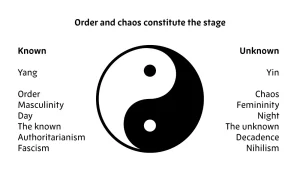
Jordan Peterson’s psychological and mythological work offers a useful language for describing what is being lost. In his lectures on Genesis and in interviews, he repeatedly frames the father as the archetype of structured order—the one who builds, protects, sets boundaries, and “confronts chaos” on behalf of his family.[source], [source], [source]
In this framing:
- Order is the domain of responsibility, structure, hierarchy of competence, and sacrifice for the future.
- Chaos is the domain of unknown, vulnerability, and potential—but also of danger and dissolution.
The modern family-collapse architecture systematically:
- Strips fathers of their authority and their ability to establish order.
- Throws women and children into increasing chaos (emotional, economic, cultural).
- Offers institutions and ideologies as a counterfeit order in place of the father and family.
XIII. Charts & Structural Maps
1. Bezmenov’s Four Stages of Subversion (Applied to Family)
| Stage | Approx. Duration | Primary Targets | Effects on Family |
|---|---|---|---|
| Demoralization | 10–20+ years | Education, media, religion, culture | Children raised without coherent moral frameworks; traditional marriage and roles mocked; patriarchy and fatherhood framed as oppressive; religion treated as superstition. |
| Destabilization | 2–5 years | Law, economy, foreign policy, social trust | Families under financial stress; conflict over unstable roles; increased divorce rates; court and welfare systems expand power over private life. |
| Crisis | Months to a few years | Political system, public order, institutions | Surges in crime, addiction, mental health breakdown; children and spouses seek security in institutions rather than family; emergency powers normalize extraordinary interference. |
| Normalization | Indefinite | Everyday life, laws, norms | Fatherless or fragmented families treated as standard; dependence on state and corporate systems baked into policy; dissent against the new order pathologized or criminalized. |
2. The Family Collapse Feedback Loop
| Step | Mechanism | Outcome |
|---|---|---|
| 1 | Demoralize and weaken men (economy, culture, law) | Men feel unnecessary, powerless, and withdraw. |
| 2 | Destabilize women (emotional validation traps, weaponized independence) | Women feel unsafe and underappreciated inside the family. |
| 3 | Collapse marital boundaries (sexualization, social media, peer validation) | Marriage moves from covenant to convenience; loyalty erodes. |
| 4 | Legal removal of protector (police, prosecutors, judges, NGOs) | Stronger link expelled from the home; labeled dangerous or abusive. |
| 5 | Institutional support & rewards for the remaining adult(s) | Dependence on state, welfare, and advocacy; estrangement reinforced. |
| 6 | Capture of children (school, peers, social media, therapy) | Children’s primary loyalties shift from family to institutional and digital tribes. |
| 7 | Normalization and repetition | Next generation grows up without intact family models; cycle deepens. |
XIV. Closing Observations
The collapse of the family is not a side-effect of “modern life.”
It is the predictable outcome of ideas, policies, incentives, and technologies that have been
converging for more than a century. From Marx and Engels calling for the end of the bourgeois family, to cultural and sexual revolutions undermining sexual ethics, to legal architectures that punish fatherhood, to digital systems that capture the minds of children—every layer pushes in the same direction:
Away from the family.
Toward the institution.
Understanding the model is not enough on its own—but it is the necessary first step for anyone who wants to resist it, expose it, or build alternatives that protect children, uphold marriage, and restore the integrity of the household as the primary unit of human life.
The family is not an outdated relic. It is the original fortress of human freedom. But more than this academic sociological understanding of the attack on the family and the incentives to gain the willing acquiescence of the validation-seeking members of society. Governments and individuals participating in the pure destruction of God’s first divine institution cuts straight to the heart of the chief aim of humanity: to glorify God and to enjoy Him for all of eternity.
XV. The Divine Order: Marriage and Family as God’s First Institution

Every sociological force described in this dossier is real. Every political mechanism is observable.
Every legal pressure point is traceable. Every psychological vector is measurable.
But none of these explain the full weight of the attack.
The destruction of the family is not merely cultural or political.
It is spiritual rebellion against the oldest, most sacred institution God ever established.
“So God created man in His own image; in the image of God He created him; male and female He created them.
Then God blessed them, and God said to them, ‘Be fruitful and multiply; fill the earth and subdue it.’”
— Genesis 1:27–28
Before law, before government, before religion, before nations, before the Church—God established:
- Marriage (Genesis 2:24)
- Family (Genesis 4:1)
- Fatherhood as His earthly reflection (Ephesians 3:14–15)
- Motherhood as life-bearing covenant (1 Timothy 2:15)
- Children as divine heritage (Psalm 127:3)
1. Marriage Is Not a Social Contract — It Is a Divine Covenant

Modern culture treats marriage as a reversible emotional arrangement. Scripture rejects that entirely.
A marriage covenant is invoked, witnessed, and sealed by God Himself.
“The Lord has been witness between you and the wife of your youth… she is your companion and your wife by covenant.”
— Malachi 2:14
This is why modern ideological systems hate marriage:
because it is the one structure not authored by human power.
2. Fatherhood Reflects God’s Own Identity — So the System Targets It First

Scripture reveals God as:
- Father (Matthew 6:9)
- Protector (Psalm 91)
- Provider (Matthew 6:26)
- Corrector (Hebrews 12:7–8)
- Supreme Authority (Ephesians 4:6)
God imprinted these attributes into earthly fathers.
A righteous father is a threat to every godless system.
This is why:
- the father is removed first, with maximum legal force,
- his authority is mocked and called “patriarchy,”
- his masculinity is pathologized and criminalized,
- his presence is reclassified as a risk factor instead of a blessing.
Breaking the father breaks the spiritual shield around the home.
3. Motherhood as a Divine Trust — Not a Disposable Role

Motherhood is honored by Scripture as a holy calling:
“Her children rise up and call her blessed; her husband also, and he praises her.”
— Proverbs 31:28
“Now Adam knew Eve his wife, and she conceived and bore Cain, and said, ‘I have acquired a man from the LORD.’”
— Genesis 4:1
Modern culture attempts to invert motherhood by preaching:
- “Children are burdens.”
- “Family limits your potential.”
- “Career is who you are; motherhood is optional.”
- “Marriage traps you; independence sets you free.”
This deliberately destabilizes the mother—spiritually, emotionally, and relationally—so institutions can
replace what God designed the household to provide.
4. Children as the Battlefield of the Next Generation

“Behold, children are a heritage from the LORD, the fruit of the womb is His reward.”
— Psalm 127:3
Heritage means:
- inheritance,
- continuity,
- legacy,
- spiritual succession.
Whoever shapes the children owns the future.
Schools, media, activist networks, and digital platforms do not merely “influence” children—they compete to
re-parent them, to overwrite whatever the family has established.
5. The Family Is a Parallel Kingdom — Not a Social Accident

God designed the family as a micro-kingdom:
- Husband as head (Ephesians 5:23)
- Wife as co-heir of grace (1 Peter 3:7)
- Children as arrows in the hand of a warrior (Psalm 127:4)
- Home as a teaching sanctuary (Deuteronomy 6:6–7)
A family that governs itself does not need the State to govern it.
A family that teaches truth cannot be propagandized.
A family that walks with God cannot be fully controlled.
Household Spiritual Command Structure (and Its Counterfeit)
| God’s Design | Scriptural Axis | System’s Counterfeit |
|---|---|---|
| God → Christ → Husband → Wife → Children | 1 Corinthians 11:3; Ephesians 5:22–25 | State → Institutions → Children → Isolated Adults |
| Authority flows downward in love, sacrifice, and responsibility; loyalty flows upward in honor and obedience. |
Ephesians 6:1–4; Colossians 3:18–21 | Authority flows from bureaucracies, courts, and technocracies; loyalty is re-routed away from the home toward systems. |
| Discipleship happens primarily in the home; the world is secondary. |
Deuteronomy 6:6–9 | Discipleship happens through school, media, and algorithms; the home is an afterthought. |
| The family is a covenant unit that answers first to God. | Joshua 24:15 | The family is a temporary cluster of individuals who answer first to the State and the culture. |
6. The War Against the Family Is a War Against God
“The thief does not come except to steal, and to kill, and to destroy. I have come that they may have life, and that they may have it more abundantly.”
— John 10:10
Every government policy, cultural inversion, academic theory, and digital psychological weapon aimed at the family is, at root, an assault on the image of God in man and the order God has declared good.
The enemy wants:
- men passive and absent,
- women destabilized and overwhelmed,
- children confused and indoctrinated,
- marriage desecrated and discarded,
- sex corrupted and commodified,
- identity fragmented beyond recognition,
- authority inverted,
- and ultimately the image of God smeared and erased.
Break the household → break the covenant → break the nation → break the faith.
7. God’s Design Remains — Even in a Collapsing World
This page is a problem-mapping document, not a solutions manual. The point is exposure, not yet
reconstruction. But even at this analytical level, one truth refuses to disappear:
God’s design has not changed just because the world rebelled against it.
Systems can redefine words, rewrite laws, reprogram schools, redesign media, and rewire the psychology of entire populations. They cannot invalidate what God has already declared.
8. Prophetic Exhortation: The Line Is Being Drawn

The choice in this generation is not abstract or theoretical. It is no longer a polite disagreement over
“values.” It is a collision between two orders:
- One order comes from God, who created male and female, marriage and children, covenant and faithfulness.
- The other comes from a world system that must annihilate those things to maintain control.
“And if it seems evil to you to serve the LORD, choose for yourselves this day whom you will serve…
But as for me and my house, we will serve the LORD.”
— Joshua 24:15
This dossier has mapped the mechanisms of destruction. The next work will map restoration.
For now, it is enough to say this:
The family is God’s fortress in a collapsing world.
The systems of this age are doing everything they can to breach it.
Understanding the attack is not optional anymore. It is survival.